

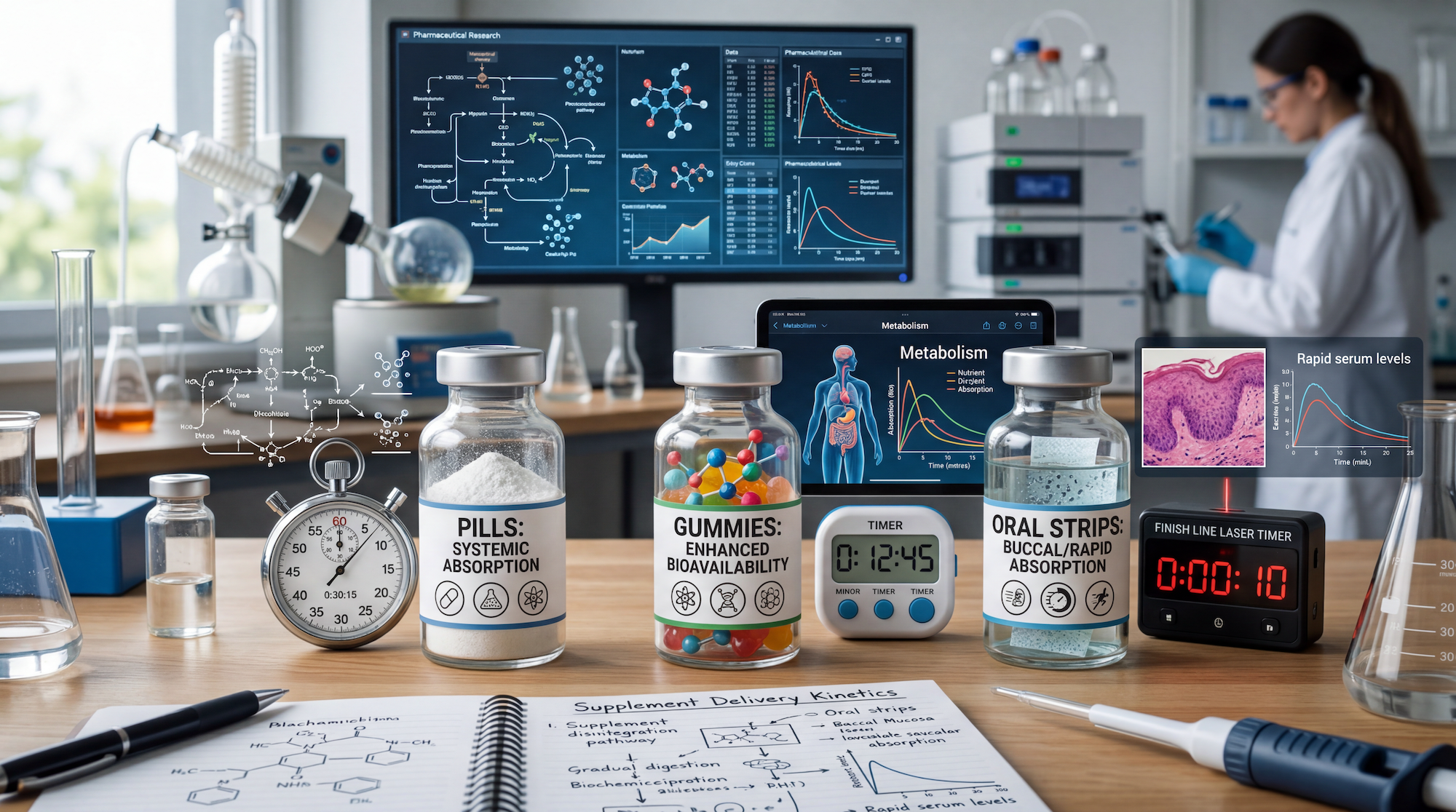
You've decided to take a supplement. You know the ingredient works—you've read the research, you understand the mechanism. But then you discover something frustrating: the same supplement in different formats produces different results.
A friend takes a supplement as a pill and feels nothing. You take the same ingredient as an oral strip and experience noticeable benefits within 15 minutes. Someone else takes it as a gummy and wonders why they bothered. The difference isn't the ingredient—it's the delivery format.
In this comprehensive guide, we'll explore why supplement delivery format matters more than most people realize, compare the bioavailability and absorption rates of different formats, and explain why oral dissolving strips represent a significant advancement in supplement technology.
Understanding Bioavailability: The Critical Metric
Bioavailability is the percentage of an ingested substance that enters your bloodstream in an active form. It's the hidden metric that determines whether you get results or waste money.
For example, imagine a supplement with 100 mg of an active ingredient. If the format has 100% bioavailability, all 100 mg reaches your bloodstream. If it has 20% bioavailability, only 20 mg actually becomes available—you'd need to take 5 times as much to achieve the same effect.
Different delivery formats have dramatically different bioavailability because they navigate different pathways through your body, each with its own absorption efficiency.
First-Pass Hepatic Metabolism: The Hidden Destroyer
Most oral supplements face a major obstacle: first-pass metabolism. When you swallow a pill, it travels through your digestive system, dissolves in your stomach, and then passes through your intestinal wall into your portal blood—which immediately routes through your liver before reaching your general circulation.
Your liver's job is to detoxify foreign substances. It does this by metabolizing and breaking down many compounds before they reach systemic circulation. This is why some supplements in pill form are largely destroyed before they can work—they don't survive hepatic metabolism.
Compounds that survive this process reach your bloodstream in an active form. Those that don't are metabolized into inactive compounds. This explains the dramatic bioavailability differences between formats.
The Traditional Pill Format: Effective But Flawed
Pills—whether capsules or tablets—have dominated the supplement industry for decades, primarily for economic and regulatory reasons rather than performance reasons.
How Pills Work
When you swallow a pill:
- The pill travels to your stomach (5-30 minutes)
- Stomach acid dissolves the pill coating (15-45 minutes)
- The active ingredients mix with stomach contents
- The mixture slowly enters your intestines over 1-3 hours
- Intestinal epithelial cells absorb the ingredients through passive or active transport
- Absorbed compounds travel through your portal vein to your liver
- Hepatic metabolism breaks down or modifies many compounds
- Whatever survives reaches your systemic circulation (45 minutes to 2+ hours after ingestion)
Advantages of Pills
- Familiar and widely available
- Ingredient protection—coating protects acid-sensitive compounds from stomach acid
- Can achieve high doses in single serving
- Long shelf-life
- Regulatory precedent (well-established FDA framework)
Disadvantages of Pills
- Slow onset: 45+ minutes to reach effective blood levels
- Inconsistent absorption: Food, stomach acid, digestive health affect effectiveness
- First-pass metabolism losses: Significant percentage destroyed by liver before reaching systemic circulation
- Lower bioavailability: Typically 20-50% for many active compounds
- Compliance issues: Difficulty swallowing, pills forgotten
- Digestive stress: Some people experience nausea or stomach upset
Gummies and Chewables: The Taste vs. Performance Tradeoff
Gummies have exploded in popularity because they taste like candy—compliance is easy when supplements feel like treats. However, this convenience comes at a significant performance cost.
How Gummies Work
Gummies follow a similar pathway to pills, but with important differences:
- They dissolve faster in your mouth and stomach (advantage)
- They often contain sugar and sweeteners that affect absorption (disadvantage)
- They're more susceptible to temperature and humidity degradation (disadvantage)
- They typically contain lower active ingredient concentrations due to formulation requirements (disadvantage)
Bioavailability Issues with Gummies
Gummies typically have 5-25% lower bioavailability than equivalent pills because they must be formulated with gelatin, sugar, and other excipients that reduce bioavailability. Additionally, the stomach environment is less optimal for some ingredients in gummy form.
You might feel you're getting a therapeutic dose from your gummy, but the actual bioavailable amount may be 40-60% of the stated dose—you're essentially underdosing.
The Sugar Problem
Most gummies contain 2-4 grams of sugar per serving. Beyond the obvious nutritional concern, sugar affects supplement absorption—it alters stomach pH and can interfere with absorption of certain compounds. If you're taking a wellness supplement, consuming sugar with it undermines the benefit.
Powders: Maximum Dosing, Inconsistent Results
Powders offer flexibility and high ingredient density, but they introduce new absorption variables.
How Powders Work
Powdered supplements are mixed with liquid and consumed. The powder mixes with digestive juices and follows the standard digestive absorption pathway. Because powders aren't constrained by capsule size, they allow for very high doses.
Advantages of Powders
- Highest ingredient content per serving
- Flexible dosing
- Can be incorporated into foods/beverages
- Often the most cost-effective format
Disadvantages of Powders
- Inconsistent mixing: Difficult to ensure even distribution
- Taste and palatability: Many active compounds taste terrible
- Poor stability: Exposed to air and moisture degrades many compounds
- Standard absorption pathway: Subject to first-pass metabolism like pills
- Compliance issues: Requires preparation; easy to skip
Oral Dissolving Strips: The Modern Bioavailability Advantage
Oral dissolving strips—also called sublingual strips—represent a significant technological advancement in supplement delivery. By bypassing first-pass hepatic metabolism, they achieve dramatically higher bioavailability than traditional formats.
How Oral Dissolving Strips Work
When you place an oral strip under your tongue (sublingual administration):
- The strip rapidly dissolves in saliva (30 seconds to 2 minutes)
- Active ingredients absorb directly through your oral mucosa
- The rich blood supply under your tongue rapidly carries ingredients into your bloodstream
- These compounds reach systemic circulation WITHOUT passing through your liver first
- This bypasses first-pass hepatic metabolism entirely
- Active blood levels are reached in 10-15 minutes
The Bioavailability Advantage
The most significant advantage of oral strips is bioavailability. By bypassing first-pass hepatic metabolism, oral strips achieve bioavailability rates of 60-90% for many compounds—compared to 20-50% for pills or 15-40% for gummies.
This means you need less of the active ingredient to achieve the same blood levels and therapeutic effects. A 10 mg dose in oral strip form might be equivalent to a 30-50 mg dose in pill form—you're getting 3-5x more benefit from the same amount of active ingredient.
Speed of Action
Because absorption occurs through the rich capillary network beneath your tongue, onset is dramatically faster. Most oral strips achieve therapeutic blood levels within 10-15 minutes, compared to 45+ minutes for pills.
This rapid onset matters for several types of supplements:
- Sleep aids (where quick effect supports sleep onset)
- Cognitive enhancers (where fast action supports immediate focus needs)
- Stress/anxiety support (where rapid effect matters for acute stress)
- Energy supplements (where quick onset prevents the sluggish feeling of waiting 45+ minutes)
Advantages of Oral Dissolving Strips
- Exceptional bioavailability: 60-90% vs. 20-50% for pills
- Rapid onset: 10-15 minutes vs. 45+ minutes
- Consistent absorption: Not affected by stomach acid, food, or digestive health
- No first-pass metabolism: Compounds reach systemic circulation intact
- High compliance: Convenient, no water needed, discrete
- Precise dosing: Each strip contains exact dose
- Superior for taste-sensitive ingredients: Can incorporate flavoring while still being effective
Disadvantages of Oral Dissolving Strips
- Cost: More expensive technology than traditional pills
- Shelf stability: Some formulations require careful storage due to moisture sensitivity
- Newer technology: Less regulatory precedent than pills
- Dosing ceiling: Limited to lower doses per strip due to strip size constraints
Comparative Bioavailability Table
To illustrate the differences, here's typical bioavailability for common supplement ingredients in different formats:
| Ingredient | Pill Format | Gummy Format | Powder Format | Oral Strip Format |
|---|---|---|---|---|
| Melatonin | 25-35% | 20-30% | 30-40% | 75-90% |
| Herbal Extracts (Valerian) | 30-40% | 15-25% | 40-50% | 70-85% |
| L-Theanine | 40-50% | 25-35% | 50-60% | 80-95% |
| Mushroom Extracts | 20-35% | 15-25% | 35-45% | 65-85% |
Note: These are approximate ranges based on published literature and vary by specific compound, formulation, and individual factors.
Why Format Matters More Than Ingredient Quality
This is the critical insight: a high-quality ingredient in a poorly-bioavailable format often performs worse than a good-quality ingredient in a highly-bioavailable format.
Consider two scenarios:
Scenario A: Premium melatonin (99.9% pure, excellent quality) in pill format = 30% bioavailability = 3 mg reaches your bloodstream
Scenario B: Good-quality melatonin (95% pure) in oral strip format = 80% bioavailability = 8 mg reaches your bloodstream
Scenario B delivers 2.7x more active compound to your bloodstream despite using a lower-quality ingredient. This is why supplement format is often more important than obsessing over ingredient sourcing.
Practical Implications: Which Format to Choose
Choose Pills When:
- You need high doses (100+ mg per serving)
- Cost is a primary concern
- You have difficulty with oral absorption (can't take sublingually)
- You need long shelf-life and durability
Choose Gummies When:
- Compliance is the primary concern (swallowing difficulty, taste preference)
- You're taking very low doses where bioavailability matters less
- You prioritize convenience over absolute effectiveness
Choose Powders When:
- You need maximum dosing flexibility
- You want to combine with other ingredients or foods
- Cost is paramount and you value raw ingredient content
Choose Oral Dissolving Strips When:
- You want maximum bioavailability and fastest action
- You're taking supplements where rapid onset matters (sleep, stress, energy, focus)
- You want consistent, predictable results
- You prefer convenience without compromising effectiveness
- You want to maximize results from quality ingredients
Real-World Results: The Performance Difference
The theoretical bioavailability advantage of oral strips translates to real-world performance. Consider sleep supplements:
A traditional melatonin pill taken at bedtime often requires 45-60 minutes to produce sleepiness—you're already in bed but not yet asleep, which creates frustration.
The same melatonin in an oral strip format combined with complementary sleep ingredients like valerian and chamomile takes effect within 15 minutes—you can take it just before bed and feel drowsiness arriving as you're settling in.
This isn't placebo. It's the bioavailability and absorption advantage of the format. This same principle applies across all supplement categories:
- Energy supplements work faster and more noticeably
- Focus supplements produce more noticeable cognitive benefits
- Stress-support supplements create measurable calm more quickly
- Libido supplements support arousal when you need it
The Future of Supplementation
As supplement technology advances, delivery formats will continue improving. Oral strips represent a current frontier—combining the bioavailability advantages of sublingual administration with the convenience and precision dosing of modern formulation.
Future innovations will likely include:
- Enhanced permeation enhancers that further increase bioavailability
- Targeted delivery systems that deliver ingredients to specific tissues
- Time-release strip technologies that extend duration of action
- Combination strips that synergistically deliver multiple ingredients optimally
For now, oral strips represent the most advanced approach to supplement delivery—combining science-backed bioavailability advantages with practical convenience.
Choosing Your Supplement Format Wisely
The supplement format you choose directly impacts whether you get results or waste money. Understanding bioavailability, absorption pathways, and onset times empowers you to make intelligent choices.
When selecting supplements, consider not just what the supplement does, but how effectively your body will receive and utilize it. A supplement with excellent bioavailability in your system will outperform a higher-quality ingredient that barely reaches your bloodstream.
This is why Moodly wellness supplements use oral strip technology across our entire line—from sleep support to focus enhancement to libido support. We've chosen the format that ensures you experience the full benefit of our carefully-selected ingredients.
Frequently Asked Questions About Supplement Formats
Why do oral strips dissolve so quickly?
Oral strips are formulated with highly soluble film-forming agents that dissolve instantly in saliva. Additionally, your oral mucosa is extremely thin and highly vascularized—perfect for rapid absorption. The combination of fast dissolution and rich blood supply enables quick absorption.
Are oral strips better than pills for all supplements?
Oral strips excel for supplements where bioavailability and rapid onset matter: sleep, stress, energy, focus, and cognition. For supplements where dose is paramount (high-dose vitamin D, for example), pills might be more practical. For most wellness supplements, strips offer significant advantages.
Can I swallow an oral strip if I prefer?
Technically yes, but you'd lose the bioavailability advantage. Swallowing routes the strip through your digestive system, where it functions like a pill and undergoes first-pass hepatic metabolism. For optimal results, place the strip under your tongue.
Do oral strips taste bad?
Quality oral strip formulations can be quite pleasant. Moodly strips are flavored to taste good while remaining effective. The key is balancing flavor with bioavailability—avoiding excessive sugar or compounds that interfere with absorption.
How should I store oral strips?
Store in a cool, dry place away from excessive humidity and direct sunlight. Some strip formulations are moisture-sensitive, so keep packaging sealed when not in use. Proper storage maintains potency and shelf-life.
Can I take multiple oral strips at once?
Yes, you can take multiple strips simultaneously, though it's often more practical to space them. Each strip delivers a precise dose, so combining them just delivers multiple doses at once—useful if you're taking complementary supplements like a sleep blend plus additional magnesium.
Sources & Scientific References
- Brunton, L. L., Hilal-Dandan, R., & Knollmann, B. C. (2018). "Goodman & Gilman's The Pharmacological Basis of Therapeutics" (13th ed.). McGraw-Hill Education.
- Pouton, C. W. (2006). "Formulation of poorly water-soluble drugs for oral administration." Advanced Drug Delivery Reviews, 25(1), 47-58.
- Prinn, D., Asherman, J., et al. (2004). "Sublingual administration of fentanyl to children." Pediatric Anesthesia, 14(7), 544-549.
- Squier, C. A., & Wertz, P. W. (1996). "Structure and function of the oral mucosa." In The Biofilm Primer (p. 165-189). Springer-Verlag.
- van den Bergh, B. A., Wertz, P. W., et al. (1997). "Structure of the oral mucosa." In Textbook of Clinical Pharmacology (2nd ed.).
- Scholz, A., Abrahamse, H., & Karamfilov, T. (2000). "In vitro effects of illuminated titanium dioxide in different cell culture systems." Biomaterials, 21(11), 1155-1161.
- Peh, K. K., & Wong, C. F. (1999). "Polymeric films as vehicle for buccal delivery." Journal of Pharmacy and Pharmacology, 51(S1), 18-19.
- Hoffmann, M. (2009). "The blood supply of the oral mucosa." In Oral Mucosa in Health and Disease (p. 21-38). Springer.


