







By Alvyn Detavernier, founder of MOODLY · Updated November 2026
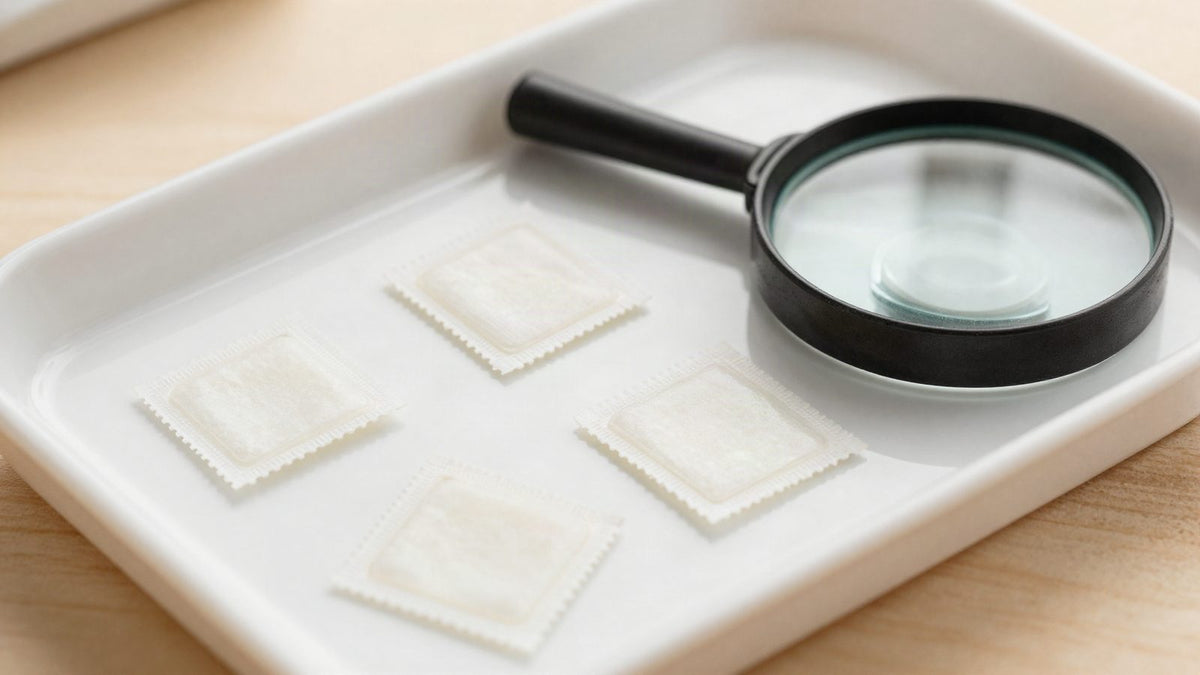
A supplement strip is a dietary supplement like any other, so the question is what is in it and how much. FDA does not approve supplements for safety before they are sold, and the company is responsible for its product [1]. The film itself is often pullulan, a food ingredient that has been through FDA's GRAS notification program [2][3].
Key facts
- FDA does not have the authority to approve dietary supplements for safety and effectiveness before they are sold [1].
- No US law limits how much of an ingredient a supplement serving can contain: the manufacturer decides [13].
- If a supplement may have caused a serious reaction, FDA says to stop using it and file a report through its Safety Reporting Portal [12].
What is a supplement strip made of?
A thin film, the dietary ingredients, a flavor and sweeteners. Pullulan, a common film former [3], is a carbohydrate made by fermentation and used in food and pharmaceutical products [4]. It went through FDA's GRAS notification program for use in food in general, and FDA had no questions [2]. That letter is not an approval.
Four of the five MOODLY strips, for example, list sugar alcohols such as erythritol, sorbitol, mannitol or xylitol, depending on the product; Focus Strips list monk fruit extract and steviol glycosides instead. FDA permits sugar alcohols as sugar substitutes [5]. It requires a laxative warning only on foods whose foreseeable daily use could reach 50 g of sorbitol or 20 g of mannitol [6].
What decides whether a strip suits you?
- The active ingredients and their amounts. The Supplement Facts panel lists each dietary ingredient and its amount per serving [1]. For vitamins and minerals, compare with the Daily Value, as in Vitamin strips.
- Your medications. Some supplements change how a medication is taken up, broken down or cleared, and you may be asked to stop supplements two or three weeks before surgery [7].
- Pregnancy and nursing. FDA advises discussing any supplement with a health care professional if you are pregnant or breastfeeding [7]. NIH notes that many supplements have not been well tested in pregnant or nursing women [8].
- Age. FDA says children could be harmed by taking both supplements and medicines [7].
FDA adds that "natural" on a label does not mean safe [1].
Is it safe to take supplement strips every day?
That depends on each ingredient and its amount. FDA's advice is to take a supplement only as its label describes, because some ingredients can be harmful in high amounts, when taken for a long time, or with certain drugs or foods [1]. For vitamins and minerals, NIH sets daily upper limits, such as 100 mcg (4,000 IU) of vitamin D for adults [9]. Our ingredients page gives the amounts and durations used in human studies of each MOODLY ingredient.
How do you keep strips away from children and pets?
Store every tin out of children's reach. For iron, FDA requires solid supplements to warn that accidental iron overdose is a leading cause of fatal poisoning in children under 6 [10]. For pets, check for xylitol, which FDA warns can have devastating effects on pets; if your dog may have eaten some, call your vet or an animal poison control center right away [11]. MOODLY Sleep Strips contain xylitol.
What about allergens?
Read the allergen statement and the other ingredients on every tin. MOODLY Libido Strips contain shellfish (oyster peptide). FDA lists itching, rash, hives, throat, lip or tongue swelling, and wheezing among serious reactions to report [12].
How can you tell a strip is well made?
FDA's regulations require those who manufacture, package, or hold dietary supplements to follow current good manufacturing practices that help ensure the identity, purity, quality, strength, and composition of dietary supplements [13]. That is a legal duty, not a certificate.
NIH says a seal from an independent organization indicates that the product was properly manufactured, contains the ingredients listed on the label and does not contain harmful levels of contaminants, and that seals do not guarantee a product is safe or effective [8]. USP says its mark means testing for the listed ingredients and amounts, for harmful levels of specified contaminants, and for breakdown within a set time [14]. NSF describes a label claim review, a toxicology review of added ingredients and a contaminant review [15].
MOODLY strips do not carry a third-party quality seal, and MOODLY has not published a certificate of analysis.
What should you do if you react to a strip?
Stop taking it and talk to a health care professional [1]. Then report it through FDA's Safety Reporting Portal [12]: FDA wants to hear about a problem even if you are unsure the product caused it and even if you did not see a doctor [13]. NIH also gives a phone line, 800-FDA-1088 [8]. Companies must pass serious adverse event reports they receive to FDA within 15 days [1]. To tell MOODLY, write to hello@moodlydaily.com.
Questions to ask, and where the label answers them
| Question to ask | Where to find the answer on the label |
|---|---|
| What is in it, and how much per strip? | Supplement Facts panel [1] |
| Are some amounts grouped in a blend? | A "proprietary blend" line with one total [16] |
| How many a day, and who should not take it? | Directions and warnings |
| What are the film and the sweeteners? | Other ingredients |
| Does it contain an allergen? | The allergen statement |
| Has FDA evaluated the claims? | The disclaimer, linked to each claim by a symbol such as an asterisk [17] |
The MOODLY rules
MOODLY strips are for adults 18 and over. Take one strip a day of a given product, at most. Do not use them during pregnancy or nursing, and ask your doctor or pharmacist first if you take medication. The five: Sleep Strips, Focus Strips, Relax Strips, Libido Strips (contains shellfish: oyster peptide) and Slim Strips, the snack-o'clock strip, all in the strips collection. More answers in the FAQ, What are oral strips? and Do oral strips work?

Sources
- US Food and Drug Administration, FDA 101: Dietary Supplements. https://www.fda.gov/consumers/consumer-updates/fda-101-dietary-supplements
- US Food and Drug Administration, GRAS Notice Inventory, GRN No. 99 (Pullulan). https://www.hfpappexternal.fda.gov/scripts/fdcc/index.cfm?set=GRASNotices&id=99
- Salawi A, Pharmaceuticals (Basel), 2022. PubMed PMID 35890143. https://pmc.ncbi.nlm.nih.gov/articles/PMC9323338/
- Prajapati VD et al., Carbohydrate Polymers, 2013. PubMed PMID 23618305. https://pubmed.ncbi.nlm.nih.gov/23618305/
- US Food and Drug Administration, Aspartame and Other Sweeteners in Food. https://www.fda.gov/food/food-additives-petitions/aspartame-and-other-sweeteners-food
- Code of Federal Regulations, 21 CFR 184.1835(e) and 21 CFR 180.25(e) (2025 edition). https://www.govinfo.gov/content/pkg/CFR-2025-title21-vol3/xml/CFR-2025-title21-vol3-sec184-1835.xml and https://www.govinfo.gov/content/pkg/CFR-2025-title21-vol3/xml/CFR-2025-title21-vol3-sec180-25.xml
- US Food and Drug Administration, Mixing Medications and Dietary Supplements Can Endanger Your Health. https://www.fda.gov/consumers/consumer-updates/mixing-medications-and-dietary-supplements-can-endanger-your-health
- NIH Office of Dietary Supplements, Dietary Supplements: What You Need to Know. https://ods.od.nih.gov/factsheets/WYNTK-Consumer/
- NIH Office of Dietary Supplements, Vitamin D: Fact Sheet for Health Professionals. https://ods.od.nih.gov/factsheets/VitaminD-HealthProfessional/
- Code of Federal Regulations, 21 CFR 101.17(e) (2025 edition). https://www.govinfo.gov/content/pkg/CFR-2025-title21-vol2/xml/CFR-2025-title21-vol2-sec101-17.xml
- US Food and Drug Administration, Paws Off Xylitol; It's Dangerous for Dogs. https://www.fda.gov/consumers/consumer-updates/paws-xylitol-its-dangerous-dogs
- US Food and Drug Administration, How to Report a Problem with Dietary Supplements. https://www.fda.gov/food/dietary-supplements/how-report-problem-dietary-supplements
- US Food and Drug Administration, Questions and Answers on Dietary Supplements. https://www.fda.gov/food/information-consumers-using-dietary-supplements/questions-and-answers-dietary-supplements
- USP, Why USP Verified Matters. https://www.quality-supplements.org/why-usp-verified-matters
- NSF, Dietary Supplement and Vitamin Certification. https://www.nsf.org/consumer-resources/articles/supplement-vitamin-certification
- Electronic Code of Federal Regulations, 21 CFR 101.36. https://www.ecfr.gov/current/title-21/section-101.36
- Electronic Code of Federal Regulations, 21 CFR 101.93. https://www.ecfr.gov/current/title-21/section-101.93
*These statements have not been evaluated by the Food and Drug Administration. This product is not intended to diagnose, treat, cure, or prevent any disease.


