







By Alvyn Detavernier, founder of MOODLY · Updated November 2026
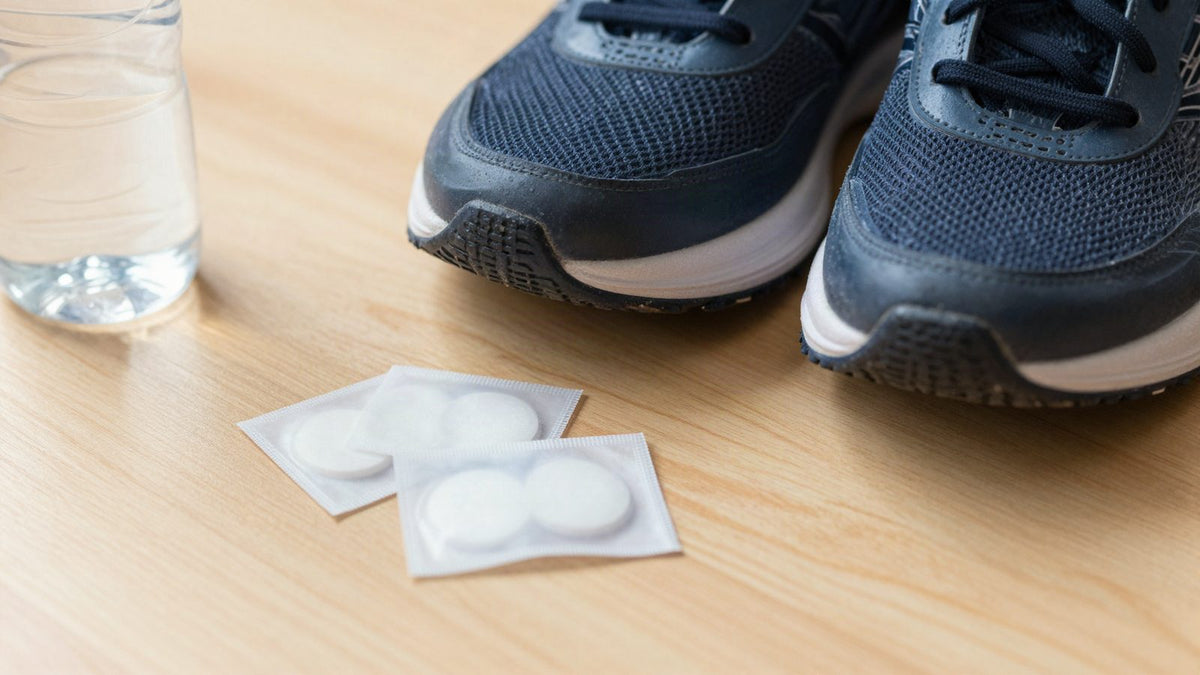
Energy strips are thin films that melt on your tongue and carry caffeine [3][8]. The active part is the caffeine, so what applies to caffeine applies to them, and the amount of caffeine per strip is the number to read. Amounts vary, so check each label.
MOODLY does not make energy or caffeine strips. This page explains the format. New to strips? Start with What are oral strips?
Key facts
- FDA cites 400 mg of caffeine a day, about two to three 12-ounce cups of coffee, as an amount not generally associated with negative effects for most adults [1].
- FDA says the body handles caffeine the same way whether it occurs naturally in coffee or tea or is added to a product, so every source counts [1].
- In a study of 14 amateur runners, caffeine taken as gum, dissolvable mouth strips or a tablet before a 5-km run gave results that did not differ significantly between forms [3].
How do caffeine strips on the tongue work?
The strip melts on your tongue, and what it carried is swallowed with your saliva [2]. We found no human study that measured blood caffeine after a caffeine strip or film. More on the format: Do oral strips work? and Vitamin strips.
Do energy strips work?
What an energy strip does comes from its caffeine. Coffee, tea and chocolate are well-known sources [1]. In a placebo-controlled trial in 20 healthy men, 160 mg of caffeine improved a reaction-time task [10].
Does the strip form change anything? Human studies cited here measured:
- Strip, gum or tablet: 14 amateur runners took about 3 to 4.5 mg of caffeine per kilogram 15 minutes before a 5-km run. The forms did not differ significantly from each other; only the tablet differed significantly from placebo. The abstract reports no blood caffeine measurement [3].
- Gum or capsule: in 84 healthy men given 50 to 200 mg, gum reached peak blood levels at 44 to 80 minutes, capsules at 84 to 120 minutes; peak levels and total exposure did not differ [4].
- Gum or instant coffee: in 16 healthy adults, about 50 mg of each peaked at similar times. Four authors worked for a gum maker [5].
- Mouth spray or drinks: in 14 adults, 60 mg by spray did not raise blood caffeine sooner than coffee or an energy drink [6].
At least two other human studies used caffeine strips or films, in hospital patients and in 13 volunteers; neither compared them with another form taken by mouth [7][8]. A study of a caffeine film in mice also turns up in PubMed; animal results are not used here.
Before anyone may claim that a form acts sooner or is taken up better, the Federal Trade Commission expects competent and reliable scientific evidence, generally randomized human trials, on a product taken the same way as the one studied; in its own example, animal and lab studies were not enough [9].
What are energy strips used for?
Perhaps a run, a study session or a long drive. In the running study above, the strip was not better than the tablet [3]; none of the studies cited here tested studying or driving. We recommend energy strips for none of these.
Are energy strips safe?
It depends on your total caffeine and on who you are; here is what FDA says.
- Daily reference: 400 mg for most adults, with wide variation in sensitivity [1].
- Ask first: some medications make people more sensitive to caffeine. If you are concerned about a medication, or are pregnant, trying to become pregnant or breastfeeding, FDA recommends asking your health care provider whether to limit caffeine [1].
- Children and teens: FDA relays pediatric advice against energy drinks for them, listing a raised heart rate, palpitations, higher blood pressure, and sleep and digestive problems [1].
- Concentrated products: FDA warns that pure and highly concentrated caffeine can have serious consequences, estimating toxic effects such as seizures with rapid intake of around 1,200 mg [1].
- Late in the day: in a home study, 400 mg, which the authors call "a moderate dose", disturbed sleep versus placebo even six hours before bed [11]. FDA lists sleep disruptions among the effects of too much caffeine [1].
- Add it up: a strip counts with your coffee and tea [1].
See also Are supplement strips safe?
What to check on the label
Start with the caffeine amount: NIH's NCCIH wrote in 2018 that energy products need not declare it [12]. If the label also lists L-theanine, compare its amount with trial amounts. In placebo-controlled trials by industry researchers, 50 mg of caffeine with 100 mg of L-theanine improved an attention-switching task in 27 people [16], and 40 mg with 97 mg improved task-switching accuracy and self-rated alertness in 44 young adults, but not other tasks [17]. A 2014 analysis of 11 placebo-controlled studies of tea compounds found moderate effects of the pair in the first 2 hours, with trends pointing more to the caffeine dose [18].
| Question | What to read on the label | Why it matters (source) |
|---|---|---|
| How much caffeine? | Milligrams per strip and per serving | Not always required; take care if undeclared [1][12] |
| How many a day? | Directions and daily maximum | Take only as labeled; no law caps the amount [13][14] |
| Hidden caffeine? | Guarana, chocolate | Caffeine from an ingredient may not say "caffeine" [1] |
| Other actives? | Each with its amount, such as L-theanine | Compare with trial amounts [16][17] |
| A blend? | "Proprietary Blend" with one total | Only the total is shown [15] |
| Sugar? | Total and added sugars | Declared when present [15] |
| Supplement Facts? | The panel and serving size | Required on supplements [13] |
Looking for a strip without caffeine?
MOODLY Focus Strips list four mushrooms, lion's mane 30 mg, maitake 25 mg, cordyceps 25 mg and shiitake 20 mg, and no caffeine on the label. They are sold as a 3 pm ritual, not as an energy product, and no study has tested them. Lion's mane studies cited here used from a single 1 g dose to 10 g a day [19][20]; details in our mushroom focus strips guide. One strip a day at most, adults 18 and over, not during pregnancy or nursing. More options: caffeine-free focus.

Sources
- US Food and Drug Administration, Spilling the Beans: How Much Caffeine is Too Much? https://www.fda.gov/consumers/consumer-updates/spilling-beans-how-much-caffeine-too-much
- Visser JC et al., International Journal of Clinical Pharmacy, 2020. PubMed PMID 32052239. https://pmc.ncbi.nlm.nih.gov/articles/PMC7192866/
- Whalley PJ et al., International Journal of Sports Physiology and Performance, 2020. PubMed PMID 31605520. https://pubmed.ncbi.nlm.nih.gov/31605520/
- Kamimori GH et al., International Journal of Pharmaceutics, 2002. PubMed PMID 11839447. https://pubmed.ncbi.nlm.nih.gov/11839447/
- Sadek P et al., Journal of Caffeine Research, 2017. PubMed PMID 29230348. https://pubmed.ncbi.nlm.nih.gov/29230348/
- McCarthy DG et al., European Journal of Applied Physiology, 2025. PubMed PMID 40000478. https://pubmed.ncbi.nlm.nih.gov/40000478/
- Elsadany M et al., Journal of Nuclear Cardiology, 2023. PubMed PMID 35794456. https://pubmed.ncbi.nlm.nih.gov/35794456/
- Batista P et al., Bioengineering (Basel), 2022. PubMed PMID 35324803. https://pubmed.ncbi.nlm.nih.gov/35324803/
- Federal Trade Commission, Health Products Compliance Guidance, December 2022. https://www.ftc.gov/business-guidance/resources/health-products-compliance-guidance
- Kahathuduwa CN et al., Nutritional Neuroscience, 2017. PubMed PMID 26869148. https://pubmed.ncbi.nlm.nih.gov/26869148/
- Drake C et al., Journal of Clinical Sleep Medicine, 2013. PubMed PMID 24235903. https://pubmed.ncbi.nlm.nih.gov/24235903/
- National Center for Complementary and Integrative Health (NIH), Energy Drinks, 2018. https://www.nccih.nih.gov/health/energy-drinks
- US Food and Drug Administration, FDA 101: Dietary Supplements. https://www.fda.gov/consumers/consumer-updates/fda-101-dietary-supplements
- US Food and Drug Administration, Questions and Answers on Dietary Supplements. https://www.fda.gov/food/information-consumers-using-dietary-supplements/questions-and-answers-dietary-supplements
- Electronic Code of Federal Regulations, 21 CFR 101.36. https://www.ecfr.gov/current/title-21/section-101.36
- Owen GN et al., Nutritional Neuroscience, 2008. PubMed PMID 18681988. https://pubmed.ncbi.nlm.nih.gov/18681988/
- Giesbrecht T et al., Nutritional Neuroscience, 2010. PubMed PMID 21040626. https://pubmed.ncbi.nlm.nih.gov/21040626/
- Camfield DA et al., Nutrition Reviews, 2014. PubMed PMID 24946991. https://pubmed.ncbi.nlm.nih.gov/24946991/
- Grozier CD et al., International Journal of Exercise Science, 2022. PubMed PMID 36582308. https://pubmed.ncbi.nlm.nih.gov/36582308/
- La Monica MB et al., Nutrients, 2023. PubMed PMID 38140277. https://pmc.ncbi.nlm.nih.gov/articles/PMC10745489/
*These statements have not been evaluated by the Food and Drug Administration. This product is not intended to diagnose, treat, cure, or prevent any disease.


