







By Alvyn Detavernier, founder of MOODLY · Updated November 2026
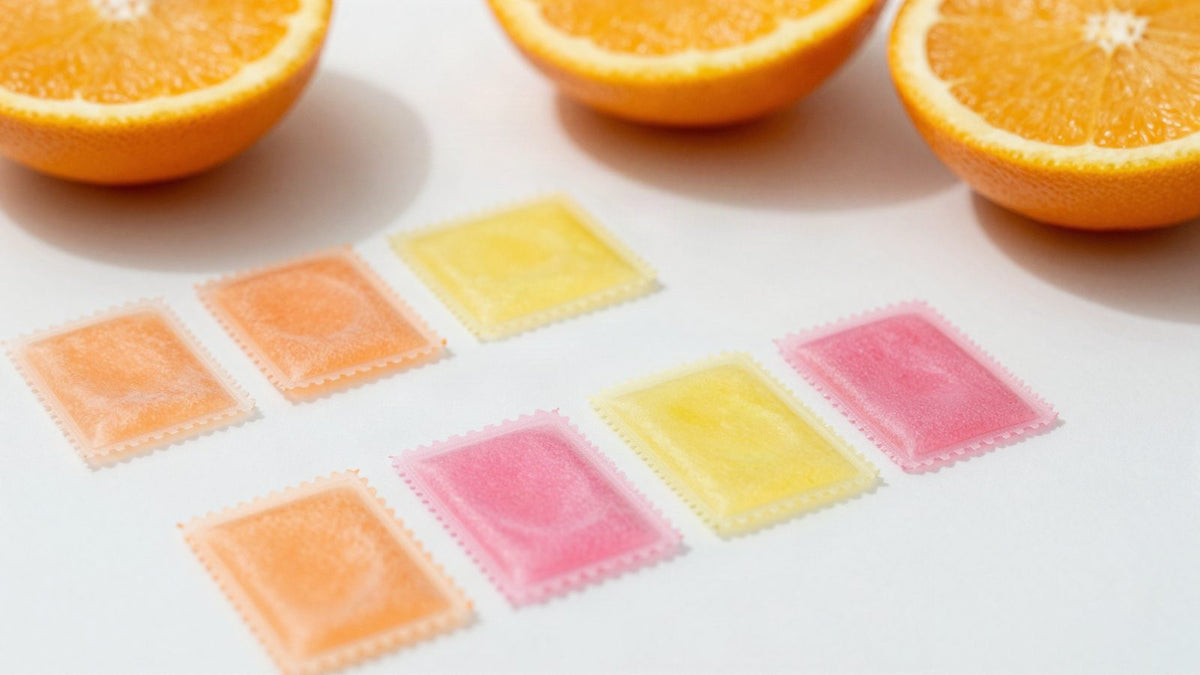
Vitamin strips are thin films that melt on your tongue and carry a vitamin or mineral. A film holds only tens of milligrams of active ingredient [1], so strips suit nutrients needed in micrograms or a few milligrams, such as vitamin B12, vitamin D or zinc. They cannot carry a full Daily Value of magnesium, which is 420 mg [2].
MOODLY does not make vitamin strips. This page explains the format. Start with What are oral strips?
Key facts
- Pharmaceutical researchers use roughly 50 mg of active ingredient per oral film as a rule of thumb, not a hard limit [1].
- The US Daily Value is 2.4 mcg for vitamin B12, 20 mcg for vitamin D, 18 mg for iron, 11 mg for zinc and 420 mg for magnesium [2].
- A strip carrying 50 mg of pure magnesium would give about 12% of its 420 mg Daily Value [1][2].
- NIH says evidence suggests no difference between swallowed B12 and B12 tablets or lozenges held under the tongue [3].
Which vitamins and minerals fit in a strip?
| Nutrient | Daily Value [2] | Fits in about 50 mg? | Form comparisons in people |
|---|---|---|---|
| Vitamin B12 | 2.4 mcg | Yes: even 1,000 mcg is 1 mg [3] | Tablet held under the tongue vs swallowed: no significant difference, in adults with low levels of the vitamin [4][5]. No strip study found in our search |
| Vitamin D | 20 mcg | Yes: 20 mcg is 0.02 mg | Film vs liquid: very similar, no significant difference; the authors describe the film's result as slightly higher [7]. Spray vs capsule: results differ by study [9][10][11] |
| Iron | 18 mg | A stretch: 30 mg of iron took 120 to 150 mg of iron salt [14] | Film vs capsule: comparable, equivalence not confirmed [14] |
| Zinc | 11 mg | On paper: the compound weighs more than the zinc [16] | None found in our search |
| Magnesium | 420 mg | No: 50 mg is about 12% of it [1] | None found in our search |
Do vitamin B12 strips work?
We searched PubMed and found no human study comparing a B12 strip or film with a B12 tablet. The amount is no obstacle: B12-only supplements typically hold 500 to 1,000 mcg [3].
NIH says no evidence indicates that one form of B12 is taken up better than another [3].
Most of the comparisons cited here enrolled adults with low levels of the vitamin. In 30 such adults, 500 mcg a day raised levels with no significant difference between a tablet held under the tongue and one swallowed [4]. A 2024 analysis of 13 studies in a clinical population ranked under the tongue above swallowed, but the difference was not statistically significant [5].
In 16 adults, though, a study run by a spray's developer found that a B12 mouth spray gave higher blood levels over six hours than tablets at the same dose [6].
What do studies of vitamin D3 strips show?
At least two studies gave vitamin D3 films to healthy adults. In one, 48 adults took a single 25,000 IU dose, far above a daily amount, as a film or a liquid: blood levels were very similar and did not differ significantly, and the authors, funded by the film's maker, described the film's result as slightly higher [7]. In the other, a study of 45 healthy adults, a 2,000 IU film taken daily for 8 weeks raised vitamin D levels in those who took it; the comparison was no supplement rather than a pill, and a supplement company provided the vitamin D free of charge [8].
Mouth sprays went both ways: no significant difference from capsules in two trials of healthy adults [9][10], about twice the rise of a softgel in a third [11]. A review of four trials concluded that the spray does not appear superior to other forms [12]. NIH sets the adult upper limit at 100 mcg (4,000 IU) a day [13].
Can a strip carry iron?
One iron film needed 120 to 150 mg of iron salt to carry 30 mg of iron [14]. In 9 healthy women, it gave blood iron levels comparable to a capsule after one dose, but a formal equivalence test did not confirm it, and the authors called the results merely descriptive [14]. The adult upper limit for iron is 45 mg [15].
What are zinc strips and magnesium strips used for?
They carry zinc or magnesium, and what matters is the share of the Daily Value one strip holds. Zinc fits on paper: adults need 8 to 11 mg a day, the upper limit is 40 mg, and the label lists the zinc itself, not the whole compound that carries it [16]. Magnesium does not: adults need 310 to 420 mg a day [17], so a strip holds only a small share. We searched PubMed and found no human study of a zinc or magnesium strip or film.
What should you check on a vitamin strip label?
- Amount per strip against the Daily Value. No law caps the amount per serving: the maker decides [18].
- The form, named after "as", for example "zinc (as zinc citrate)".
- Sugar. It appears on the panel when a serving holds more than the amount that can be declared as zero [19].
- A proprietary blend, which gives one total instead of individual amounts [19].
Who should ask a doctor or pharmacist first?
Ask first if you take medication or have surgery planned; some supplements change how a medication is taken up or cleared [20]. FDA advises discussing any supplement with a health care professional during pregnancy or breastfeeding [20], and NIH notes that many supplements have not been well tested in children or in pregnant or nursing women [21]. Keep iron out of children's reach: FDA requires a poisoning warning on solid iron supplements [22].
Where MOODLY fits

MOODLY makes five strips: sleep, focus, relax, libido, and Slim Strips, the snack-o'clock strip. None is sold as a vitamin strip, though Relax Strips include vitamin B6 (6 mg) and Slim Strips include chromium (75 mcg). See every ingredient and the strips collection. We do not claim a strip does more than any other form. Read Do oral strips work?, Strips vs gummies vs pills and Are supplement strips safe?
Sources
- Visser JC et al., International Journal of Clinical Pharmacy, 2020. PubMed PMID 32052239. https://pmc.ncbi.nlm.nih.gov/articles/PMC7192866/
- Code of Federal Regulations, 21 CFR 101.9(c)(8)(iv) (2025 edition). https://www.govinfo.gov/content/pkg/CFR-2025-title21-vol2/xml/CFR-2025-title21-vol2-sec101-9.xml
- NIH Office of Dietary Supplements, Vitamin B12: Fact Sheet for Health Professionals. https://ods.od.nih.gov/factsheets/VitaminB12-HealthProfessional/
- Sharabi A et al., British Journal of Clinical Pharmacology, 2003. PubMed PMID 14616423. https://pubmed.ncbi.nlm.nih.gov/14616423/
- Abdelwahab OA et al., Irish Journal of Medical Science, 2024. PubMed PMID 38231320. https://pubmed.ncbi.nlm.nih.gov/38231320/
- Vitetta L et al., Journal of Functional Biomaterials, 2018. PubMed PMID 29361736. https://pubmed.ncbi.nlm.nih.gov/29361736/
- Radicioni M et al., Clinical Drug Investigation, 2022. PubMed PMID 35034345. https://pubmed.ncbi.nlm.nih.gov/35034345/
- Gervasi M et al., Scientific Reports, 2026. PubMed PMID 41720868. https://pubmed.ncbi.nlm.nih.gov/41720868/
- Todd JJ et al., British Journal of Nutrition, 2016. PubMed PMID 27724992. https://pubmed.ncbi.nlm.nih.gov/27724992/
- Williams CE et al., European Journal of Clinical Nutrition, 2019. PubMed PMID 31548595. https://pubmed.ncbi.nlm.nih.gov/31548595/
- Satia MC et al., Nutrition Journal, 2015. PubMed PMID 26514332. https://pubmed.ncbi.nlm.nih.gov/26514332/
- Grammatikopoulou MG et al., Nutrients, 2020. PubMed PMID 32143526. https://pubmed.ncbi.nlm.nih.gov/32143526/
- NIH Office of Dietary Supplements, Vitamin D: Fact Sheet for Health Professionals. https://ods.od.nih.gov/factsheets/VitaminD-HealthProfessional/
- Cupone IE et al., Pharmaceutics, 2023. PubMed PMID 37376024. https://pmc.ncbi.nlm.nih.gov/articles/PMC10303362/
- NIH Office of Dietary Supplements, Iron: Fact Sheet for Health Professionals. https://ods.od.nih.gov/factsheets/Iron-HealthProfessional/
- NIH Office of Dietary Supplements, Zinc: Fact Sheet for Health Professionals. https://ods.od.nih.gov/factsheets/Zinc-HealthProfessional/
- NIH Office of Dietary Supplements, Magnesium: Fact Sheet for Health Professionals. https://ods.od.nih.gov/factsheets/Magnesium-HealthProfessional/
- US Food and Drug Administration, Questions and Answers on Dietary Supplements. https://www.fda.gov/food/information-consumers-using-dietary-supplements/questions-and-answers-dietary-supplements
- Electronic Code of Federal Regulations, 21 CFR 101.36. https://www.ecfr.gov/current/title-21/section-101.36
- US Food and Drug Administration, Mixing Medications and Dietary Supplements Can Endanger Your Health. https://www.fda.gov/consumers/consumer-updates/mixing-medications-and-dietary-supplements-can-endanger-your-health
- NIH Office of Dietary Supplements, Dietary Supplements: What You Need to Know. https://ods.od.nih.gov/factsheets/WYNTK-Consumer/
- Code of Federal Regulations, 21 CFR 101.17(e) (2025 edition). https://www.govinfo.gov/content/pkg/CFR-2025-title21-vol2/xml/CFR-2025-title21-vol2-sec101-17.xml
*These statements have not been evaluated by the Food and Drug Administration. This product is not intended to diagnose, treat, cure, or prevent any disease.


