







By Alvyn Detavernier, founder of MOODLY · Updated November 2026
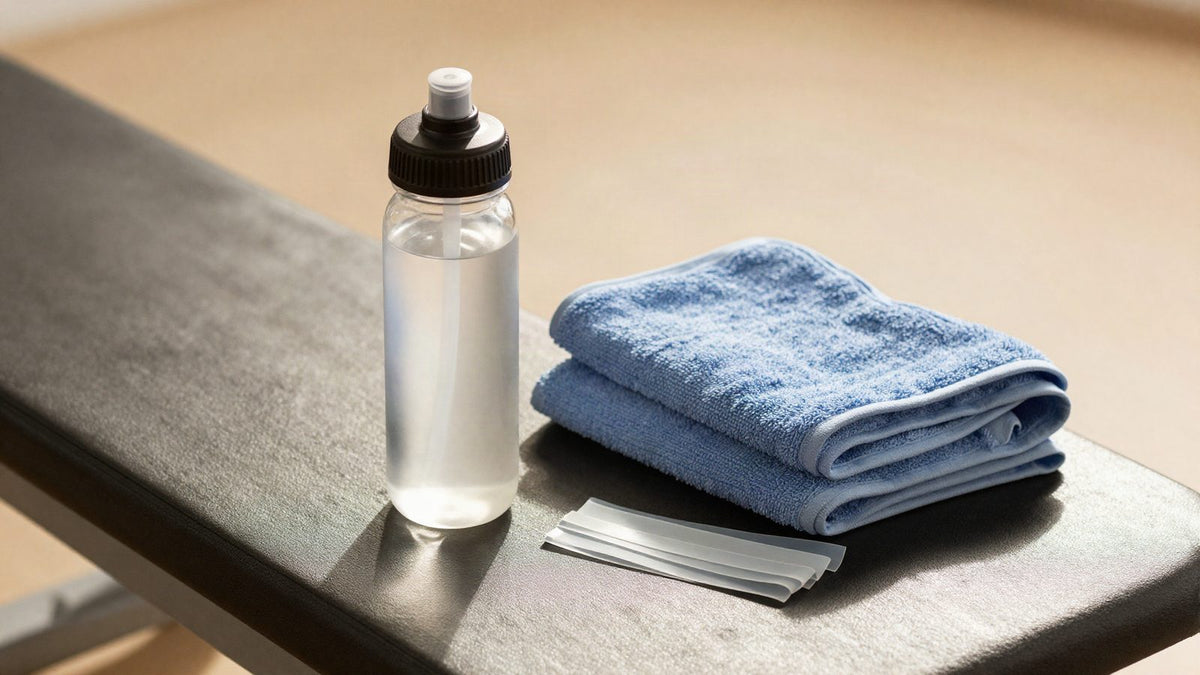
Electrolyte strips are thin films that melt on the tongue and carry minerals such as sodium or potassium. A film holds roughly 50 mg of active ingredient as a rule of thumb, while the Daily Values are 2,300 mg for sodium and 4,700 mg for potassium, so one strip supplies a small fraction, and no water [1][2][3].
MOODLY does not make electrolyte strips. This page explains the format and names no brand.
Key facts
- MedlinePlus says you lose electrolytes when you sweat and must replace them by drinking fluids that contain electrolytes [4].
- The US Daily Values for adults and children 4 and older are 2,300 mg for sodium, 4,700 mg for potassium, 2,300 mg for chloride and 420 mg for magnesium [3][5].
- NIH says most potassium-only supplements contain up to 99 mg of potassium, about 2% of the Daily Value [6].
- Pharmaceutical researchers put the practical load of an oral film at roughly 50 mg of active ingredient [2].
What are electrolyte dissolvable strips?
Electrolyte dissolvable strips are oral films that carry electrolytes, the minerals in blood and other body fluids that carry an electric charge [4]. MedlinePlus lists bicarbonate, calcium, chloride, magnesium, phosphate, potassium and sodium as the main ones [7]. Normally you get electrolytes from the foods you eat and the fluids you drink [7]. A strip puts some of them on a film instead. You take it like any oral film: place it on your tongue, let saliva break it down, and swallow with your saliva [8][2]. If it is sold as a dietary supplement, its label must say "dietary supplement" or an equivalent, and show a Supplement Facts panel [11][12].
How much can an electrolyte strip carry?
An electrolyte strip carries tens of milligrams as a rule of thumb, which is small next to the Daily Values. The table divides the 50 mg rule of thumb [2] by each Daily Value, as if a whole strip's active load were a single mineral.
| Electrolyte | Daily Value | 50 mg as a share of it |
|---|---|---|
| Sodium | 2,300 mg [3] | About 2% |
| Potassium | 4,700 mg [3] | About 1% |
| Chloride | 2,300 mg [3] | About 2% |
| Magnesium | 420 mg [5] | About 12% |
Two caveats. The 50 mg figure is a rule of thumb from drug research, not a legal limit, and a larger or thicker film can carry more [2]. And pills carry little of some electrolytes too: most potassium-only supplements stop at 99 mg [6]. For sodium, FDA notes that Americans already eat about 3,400 mg a day on average, above the Daily Value of less than 2,300 mg [9]. Adequate Intakes for potassium are 3,400 mg for men and 2,600 mg for women aged 19 to 50 [6].
Do electrolyte tongue strips replace a drink?
Electrolyte tongue strips do not replace a drink, because a strip contains no water. MedlinePlus says electrolytes lost in sweat are replaced by drinking fluids that contain electrolytes, and notes that water alone contains few of them [4]. It also says the water you take in should equal the water you lose [7]. So if you sweat heavily, plan what you drink first; a strip, if you use one, comes on top of that. A strip is taken without water, by design: saliva breaks the film down [8], and what it carried is swallowed with that saliva [2].
We searched PubMed on 14 November 2026 and found no human study of an electrolyte strip or film.
What should you check on an electrolyte oral strip label?
Check the milligrams of each mineral per strip and its percent Daily Value, because no US law limits how much of an ingredient a supplement serving can contain: the maker decides [11]. Then:
- The panel. A strip sold as a supplement shows each mineral and its amount per serving on a Supplement Facts panel [12].
- The serving. One strip, or several? Multiply.
- The percent Daily Value. Compare each figure with the table above, mineral by mineral.
- Magnesium. The adult upper limit for magnesium from supplements is 350 mg a day, and high doses can cause digestive upset [10].
- Other actives. If a strip also lists caffeine, read what are energy strips?
What a Daily Value percentage means is explained in what does Daily Value mean?
Where MOODLY fits

MOODLY makes supplement strips that melt on your tongue, one mood per tin, and none of them is an electrolyte strip. They show the same arithmetic from the other side: a nutrient needed in small amounts fits easily, which is why the 6 mg of vitamin B6 in a MOODLY Relax Strip, next to L-theanine 50 mg and GABA 25 mg, is 353% of the Daily Value. All five are in the strips collection.
Related reading
- Vitamin Strips: Which Nutrients Fit, and What Studies Found
- Breath strips vs supplement strips
- What Are Oral Strips? Supplement Strips, Explained
- Are supplement strips safe?
Sources
- Sevinç Özakar R, Özakar E, Turkish Journal of Pharmaceutical Sciences, 2021. PubMed PMID 33634686. https://pmc.ncbi.nlm.nih.gov/articles/PMC7957312/
- Visser JC et al., International Journal of Clinical Pharmacy, 2020. PubMed PMID 32052239. https://pmc.ncbi.nlm.nih.gov/articles/PMC7192866/
- Code of Federal Regulations, 21 CFR 101.9(c)(8)(iv) and (c)(9). https://www.ecfr.gov/current/title-21/section-101.9
- MedlinePlus (NIH National Library of Medicine), Electrolytes. https://medlineplus.gov/ency/article/002350.htm
- Code of Federal Regulations, 21 CFR 101.9(c)(8)(iv), 2025 edition. https://www.govinfo.gov/content/pkg/CFR-2025-title21-vol2/xml/CFR-2025-title21-vol2-sec101-9.xml
- NIH Office of Dietary Supplements, Potassium, Fact Sheet for Health Professionals. https://ods.od.nih.gov/factsheets/Potassium-HealthProfessional/
- MedlinePlus (NIH National Library of Medicine), Fluid and Electrolyte Balance. https://medlineplus.gov/fluidandelectrolytebalance.html
- Salawi A, Pharmaceuticals (Basel), 2022. PubMed PMID 35890143. https://pmc.ncbi.nlm.nih.gov/articles/PMC9323338/
- U.S. Food and Drug Administration, sodium consumer information page. https://www.fda.gov/food/nutrition-education-resources-materials/sodium-your-diet
- NIH Office of Dietary Supplements, Magnesium, Fact Sheet for Health Professionals. https://ods.od.nih.gov/factsheets/Magnesium-HealthProfessional/
- U.S. Food and Drug Administration, Questions and Answers on Dietary Supplements. https://www.fda.gov/food/information-consumers-using-dietary-supplements/questions-and-answers-dietary-supplements
- U.S. Food and Drug Administration, FDA 101: Dietary Supplements. https://www.fda.gov/consumers/consumer-updates/fda-101-dietary-supplements
*These statements have not been evaluated by the Food and Drug Administration. This product is not intended to diagnose, treat, cure, or prevent any disease.


