







By Alvyn Detavernier, founder of MOODLY · Updated November 2026
L-theanine, an amino acid found in tea, has no established Daily Value, so dosage figures come from studies [1]. Trials in two recent sleep reviews used 50 to 1,000 mg a day [14], and a 2020 review of nine trials cites 200 to 400 mg a day for stress [2]. A MOODLY Relax Strip holds 50 mg, a light dose by those standards.
Key facts
- US supplement labels show L-theanine with "Daily Value (DV) not established" [1].
- A 2020 systematic review of nine trials found that 200 to 400 mg a day "may assist" people under stressful conditions, and called for larger, longer studies [2].
- In FDA's 2026 letter, a company's summary of human trials reports no serious adverse events at up to 900 mg a day for up to 12 weeks [3].
- One lab analysis measured about 12.5 mg of L-theanine in a 200 mL (about 7 fl oz) cup of green tea [4].
How much L-theanine per day did studies use?
Trials in two recent sleep reviews used from 50 mg to 1,000 mg a day, from a single dose to eight weeks of daily use [14]. The table lists studies cited here, lowest amount first:
| Amount | Study | Who | Measured | What was found |
|---|---|---|---|---|
| 50 mg | MOODLY Relax Strip | Not studied | n/a | No study has tested this strip |
| 50 mg once | Nobre 2008 [5] | 35 healthy young adults | Brain waves at rest | More alpha activity than placebo; no mood measure in the abstract |
| 50 mg once | Dodd 2015 [6] | 24 adults | Mood, attention, brain blood flow | No effect of L-theanine on its own |
| 100 mg once | Kelly 2008 [7] | Not given in the abstract | Attention | No effects detected for L-theanine alone |
| 100 mg once | Foxe 2012 [8] | 27 participants | Two-hour attention task | Fewer errors than placebo |
| 100.6 mg a day | Baba 2021 [9] | Healthy adults aged 50 to 69 | Attention, 12 weeks | Shorter reaction time after the first dose; no effect on attention at 12 weeks |
| 200 mg a day | Hidese 2019 [10] | 30 healthy adults | Sleep and stress questionnaires, 4 weeks | Some sleep sub-scores better than placebo |
| 200 mg once | Gerolymos 2026 [11] | Meta-analysis of 31 trials | Reaction time | Shorter choice reaction time |
| 400 mg once | Dassanayake 2022 [12] | 27 healthy young adults | Brain response, listening task | A change at 400 mg only, not at 100 or 200 mg |
| 400 mg a day | Moulin 2024 [13] | 30 adults with moderate stress | Perceived stress, 28 days | Fell, about as much as with placebo |
| Up to 900 mg a day | Company summary [3] | Healthy and clinical populations | Safety, up to 12 weeks | No serious adverse events |
Both 50 mg studies in the table are small: one measured brain waves at rest, with no measure of how people felt in its abstract [5], and the other found no effect of L-theanine on its own [6]. A strip's 50 mg is a quarter of the 200 mg used in the 2019 trial that reported better sleep sub-scores [10].
What is the recommended daily dosage of L-theanine?
L-theanine has no established Daily Value: the US supplement label cited here prints "Daily Value (DV) not established" next to it [1]. A 2026 review by researchers at a company that sells L-theanine products says there is "insufficient evidence to establish optimal dosing levels" [14]. For scale, two GRAS notices to FDA described foods and drinks with up to 250 mg per serving [15], and a US supplement label in NIH's database lists 200 mg per serving [1]. Those are companies' intended uses and one label, not recommendations.
Is it safe at these amounts every day? That has its own page: is L-theanine safe to take every day?
L-theanine dosage: morning or night?
L-theanine studies have used both morning and night dosing, and we found no trial that compared the two. The 2019 trial gave 200 mg before sleep each night [10], the 2021 trial gave 100.6 mg after breakfast [9], and the 2024 trial split 400 mg between morning and evening [13]. Single-dose attention studies dosed 30 to 60 minutes before testing [11]; why that window: how long does L-theanine take to work?. More in can you take L-theanine before bed?
How does a cup of tea compare with a supplement dose?
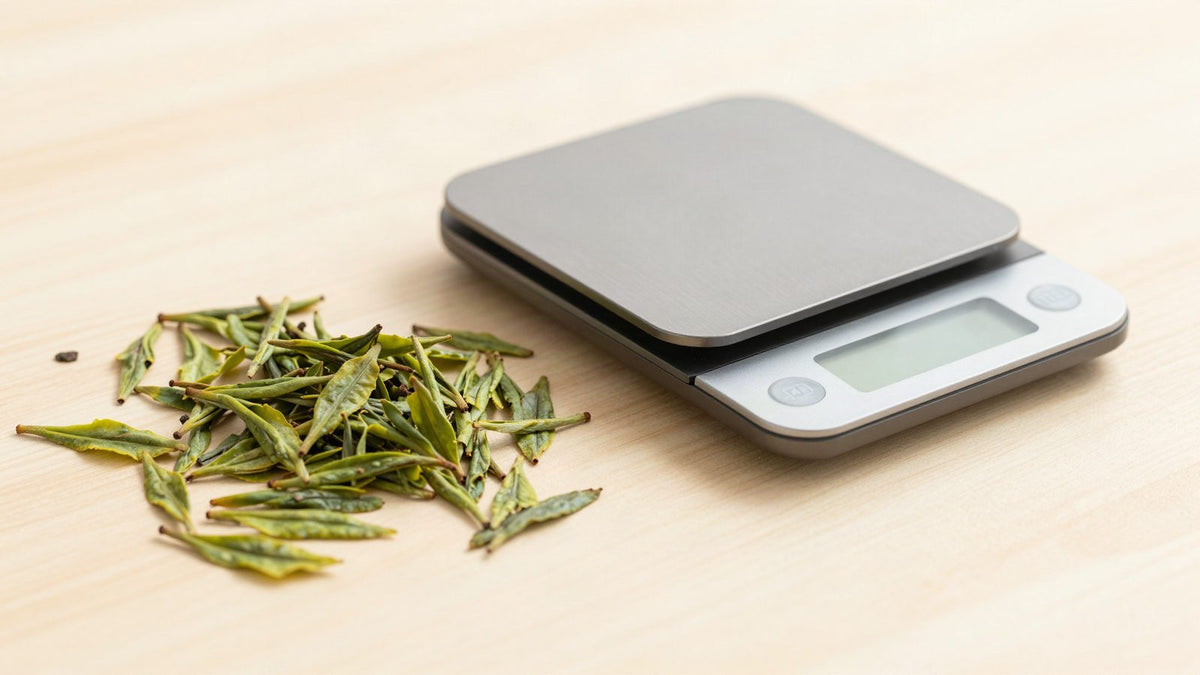
A cup of tea holds far less L-theanine than the study doses. One lab measured about 12.5 mg of L-theanine in 200 mL of green tea and 12.3 mg in black tea [4]. By that measure, 200 mg equals about 16 cups, and one 50 mg strip about four cups, in milligrams only: tea also brings caffeine [16]. See how much L-theanine is in green tea.
Where MOODLY fits

MOODLY makes supplement strips that melt on your tongue, one mood per tin. A MOODLY Relax Strip holds 50 mg of L-theanine from green tea, 25 mg of GABA and 6 mg of vitamin B6, which is 353% of the Daily Value [17] (limits: how much vitamin B6 is too much?). One strip a day at most. That 50 mg is a light dose: the studies cited here that reported a change in how people rated their sleep or stress used 200 mg a day or more [2][10]. No study has tested MOODLY Relax Strips. More in the L-theanine strips guide and on L-theanine.
Related reading
- How Much L-Theanine Is in Green Tea?
- Is L-theanine safe to take every day?
- Can You Take L-Theanine Before Bed?
- L-theanine and caffeine
Sources
- NIH Office of Dietary Supplements, Dietary Supplement Label Database. https://api.ods.od.nih.gov/dsld/s3/pdf/35455.pdf
- Williams JL et al., Plant Foods for Human Nutrition, 2020. PubMed PMID 31758301. https://pubmed.ncbi.nlm.nih.gov/31758301/
- U.S. Food and Drug Administration, response letter to GRAS Notice No. GRN 001311 (L-theanine), 2026, notifier's summary. https://www.fda.gov/media/195022/download
- Ayakdaş G, Ağagündüz D, Foods, 2025. PubMed PMID 40647065. https://pubmed.ncbi.nlm.nih.gov/40647065/
- Nobre AC et al., Asia Pacific Journal of Clinical Nutrition, 2008. PubMed PMID 18296328. https://pubmed.ncbi.nlm.nih.gov/18296328/
- Dodd FL et al., Psychopharmacology, 2015. PubMed PMID 25761837. https://pubmed.ncbi.nlm.nih.gov/25761837/
- Kelly SP et al., Journal of Nutrition, 2008. PubMed PMID 18641209. https://pubmed.ncbi.nlm.nih.gov/18641209/
- Foxe JJ et al., Neuropharmacology, 2012. PubMed PMID 22326943. https://pubmed.ncbi.nlm.nih.gov/22326943/
- Baba Y et al., Journal of Medicinal Food, 2021. PubMed PMID 33751906 (full text PMC8080935). https://pmc.ncbi.nlm.nih.gov/articles/PMC8080935/
- Hidese S et al., Nutrients, 2019. PMC6836118. https://pmc.ncbi.nlm.nih.gov/articles/PMC6836118/
- Gerolymos C et al., Molecular Psychiatry, 2026. PubMed PMID 42410082. https://pubmed.ncbi.nlm.nih.gov/42410082/
- Dassanayake TL et al., Nutritional Neuroscience, 2022. PubMed PMID 32777998. https://pubmed.ncbi.nlm.nih.gov/32777998/
- Moulin M et al., Neurology and Therapy, 2024. PubMed PMID 38758503 (full text PMC11263523). https://pmc.ncbi.nlm.nih.gov/articles/PMC11263523/
- Cotter J, Kilpatrick HE, Frontiers in Nutrition, 2026. PMC13587617. https://pmc.ncbi.nlm.nih.gov/articles/PMC13587617/
- U.S. Food and Drug Administration, GRAS Notice Inventory, GRN 209 and GRN 338. https://www.hfpappexternal.fda.gov/scripts/fdcc/index.cfm?set=GRASNotices&id=209
- NIH National Center for Complementary and Integrative Health, Green Tea. https://www.nccih.nih.gov/health/green-tea
- Code of Federal Regulations, 21 CFR 101.9(c)(8)(iv). https://www.ecfr.gov/current/title-21/chapter-I/subchapter-B/part-101/subpart-A/section-101.9
*These statements have not been evaluated by the Food and Drug Administration. This product is not intended to diagnose, treat, cure, or prevent any disease.


