







By Alvyn Detavernier, founder of MOODLY · Updated November 2026
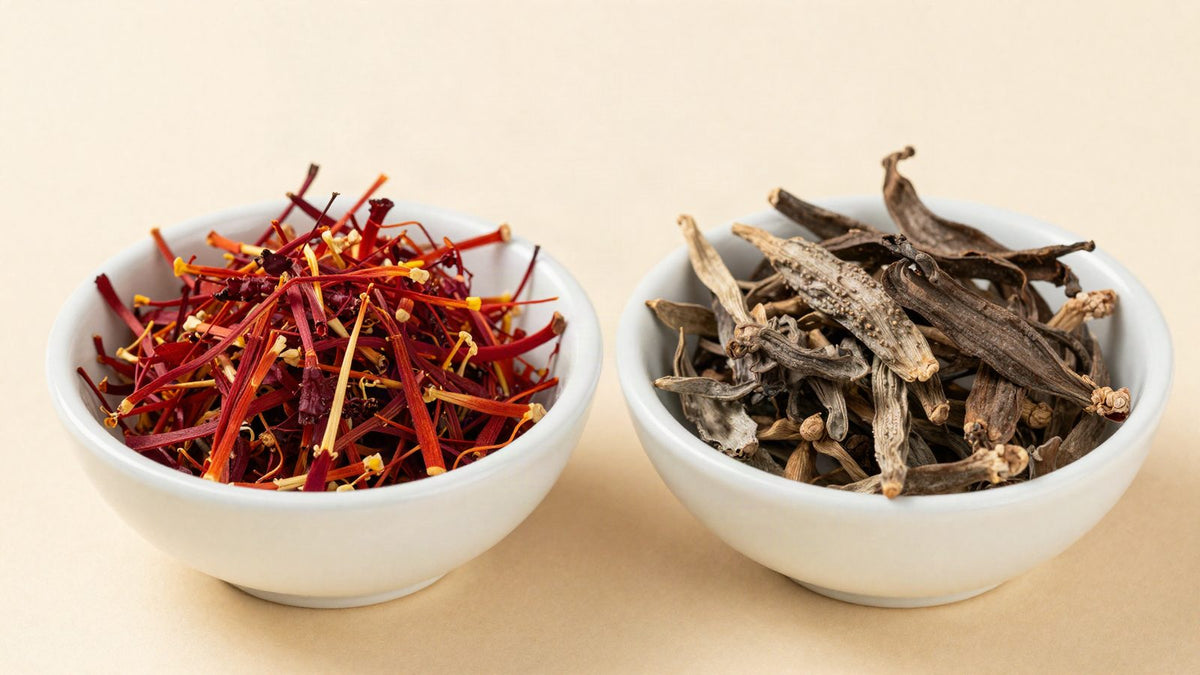
Saffron and ashwagandha are two different plants studied at very different doses. Saffron is the dried stigma of the Crocus sativus flower, and its extracts were tested at about 15 to 30 mg a day [1][4], while ashwagandha supplements mostly use root extracts of an evergreen shrub, tested at about 120 to 1,250 mg a day [2][3]. MOODLY contains no ashwagandha.
Key facts
- A 2026 systematic review of 31 randomized trials found saffron trials used 15 to 30 mg a day of standardized extract and ashwagandha trials 30 to 600 mg a day, with certainty "moderate at best" [4].
- In a 4-week trial in 128 adults with self-reported low mood, saffron at 28 mg a day lowered negative mood and stress-related symptoms versus placebo, while 22 mg a day did not [5].
- NIH reports that ashwagandha stress trials in 491 adults used 240 to 1,250 mg of extract a day for 6 to 8 weeks [3].
- NIH's NCCIH says ashwagandha should be avoided during pregnancy and has been linked, rarely, to liver injury [2].
How do saffron and ashwagandha compare side by side?
Saffron and ashwagandha differ in the plant part used, the dose and the safety notes, as this table shows.
| Saffron | Ashwagandha | |
|---|---|---|
| What it is | Dried stigma of the Crocus sativus flower [1] | Evergreen shrub; supplements mostly use root extract [2][3] |
| Daily amounts in trials | About 14 to 30 mg of extract [4][7] | About 120 to 1,250 mg of extract [3] |
| Stress | 28 mg a day for 4 weeks in 128 adults [5] | 7 trials, 491 adults, 6 to 8 weeks [3] |
| Sleep | 28 days in 63 healthy adults, and in 120 adults [6][7] | 5 trials, 372 adults, 6 to 12 weeks [3] |
| Common side effects | Digestive complaints most often, minor in most cases [8] | Loose stools, nausea, drowsiness [3] |
| Rarer concerns | One bleeding case with a blood thinner [9] | Liver injury reports; may affect the thyroid [2][3] |
| Pregnancy | Higher doses linked to miscarriage risk [10] | Avoid [2] |
| In MOODLY | 10 mg per strip of MOODLY Slim Strips | None |
Saffron vs ashwagandha for stress: what did trials find?
For stress, both plants have positive trials, at very different doses. In the saffron trial of 128 adults with self-reported low mood, 28 mg a day for four weeks lowered negative mood and stress-related symptoms compared with placebo, and 22 mg a day showed no effect [5]. For ashwagandha, NIH summarizes a review of 7 trials in 491 adults with high self-reported stress, some in clinical settings: extracts at 240 to 1,250 mg a day for 6 to 8 weeks lowered stress ratings versus placebo, and in several studies the benefits appeared greater at 500 to 600 mg [3]. NCCIH says some ashwagandha preparations "may be effective" for stress [2].
Saffron vs ashwagandha for sleep: what did trials find?
For sleep, the trials cited here for each plant were short, from 28 days to 12 weeks. Saffron at 28 mg a day for 28 days was linked with better scores than placebo on sleep questionnaires in 63 healthy adults with self-reported poor sleep [6]. In 120 adults with unsatisfactory sleep, 14 or 28 mg one hour before bed improved sleep-quality ratings but not several other measures, with similar results at both doses [7]. For ashwagandha, NIH describes a review of 5 trials in 372 adults, some healthy and some in clinical settings: 120 to 600 mg a day for 6 to 12 weeks had "a small but significant effect" on sleep [3]. The 63-adult saffron trial was funded by a company, Pharmactive Biotech Products [6].
Can you take saffron and ashwagandha together?
Saffron and ashwagandha have been given together in at least two human studies; in both studies cited here they came with other ingredients and without a placebo group, so no result can be pinned on the pair. One was an open-label 12-week study in 46 working women, with a tablet that also contained tryptophan and vitamin B6; two of its authors were company employees [11]. The other gave healthy women an oral product with L-theanine, ashwagandha and 28 mg of saffron, compared with a skin product and with both, and had no placebo arm [12]. We found no placebo-controlled trial of saffron and ashwagandha taken together as the only two ingredients.
Both have their own safety notes. Ashwagandha may interact with medicines for blood sugar, blood pressure and the thyroid, and with sedatives [2]; saffron has one reported bleeding case with a blood thinner [9]. Ashwagandha "may be safe" for up to three months, with long-term safety unknown [2], and a 2026 review advises monitoring with prolonged saffron use [8]. Taking either with a medicine, or both together? Ask your doctor first.
Where MOODLY fits

MOODLY makes supplement strips that melt on your tongue, one mood per tin. No MOODLY strip contains ashwagandha. MOODLY Slim Strips contain 10 mg of saffron (Crocus sativus) per strip, below the 14 to 28 mg in the trials above, and they are sold for the snack moment, not for stress or sleep. No study has tested them. Dose details: saffron extract dosage. The snacking research: saffron for appetite: what studies show.
Related reading
- Saffron Extract Dosage: How Much Per Day?
- L-theanine vs ashwagandha
- Saffron: what it is, how much is in a MOODLY strip, what studies used
- Saffron for appetite: what studies show
- How Long Does a Saffron Supplement Take to Work?
Sources
- Hasheminasab FS et al., Health Science Reports, 2026, full text. https://pmc.ncbi.nlm.nih.gov/articles/PMC13121846/
- NIH National Center for Complementary and Integrative Health, Ashwagandha: Usefulness and Safety. https://www.nccih.nih.gov/health/ashwagandha
- NIH Office of Dietary Supplements, Ashwagandha: Fact Sheet for Health Professionals. https://ods.od.nih.gov/factsheets/Ashwagandha-HealthProfessional/
- Alyami H, Journal of Visualized Experiments, 2026. PubMed PMID 42858054. https://pubmed.ncbi.nlm.nih.gov/42858054/
- Kell G et al., Complementary Therapies in Medicine, 2017. PubMed PMID 28735826. https://pubmed.ncbi.nlm.nih.gov/28735826/
- Lopresti AL et al., Journal of Clinical Sleep Medicine, 2020. PubMed PMID 32056539. https://pubmed.ncbi.nlm.nih.gov/32056539/
- Lopresti AL, Smith SJ, Drummond PD, Sleep Medicine, 2021. PubMed PMID 34438361. https://pubmed.ncbi.nlm.nih.gov/34438361/
- Hasheminasab FS et al., Health Science Reports, 2026. PubMed PMID 42057871. https://pubmed.ncbi.nlm.nih.gov/42057871/
- Heidari Z et al., 2022. PubMed PMID 35440328. https://pubmed.ncbi.nlm.nih.gov/35440328/
- Alshdefat A et al., Journal of Evidence-Based Integrative Medicine, 2026. PubMed PMID 42186868. https://pubmed.ncbi.nlm.nih.gov/42186868/
- Pages-García C et al., 2024. PubMed PMID 40226680. https://pubmed.ncbi.nlm.nih.gov/40226680/
- Maloh J et al., Journal of Clinical Medicine, 2022. PubMed PMID 36431167. Full text: https://pmc.ncbi.nlm.nih.gov/articles/PMC9697836/
*These statements have not been evaluated by the Food and Drug Administration. This product is not intended to diagnose, treat, cure, or prevent any disease.


