







By Alvyn Detavernier, founder of MOODLY · Updated November 2026
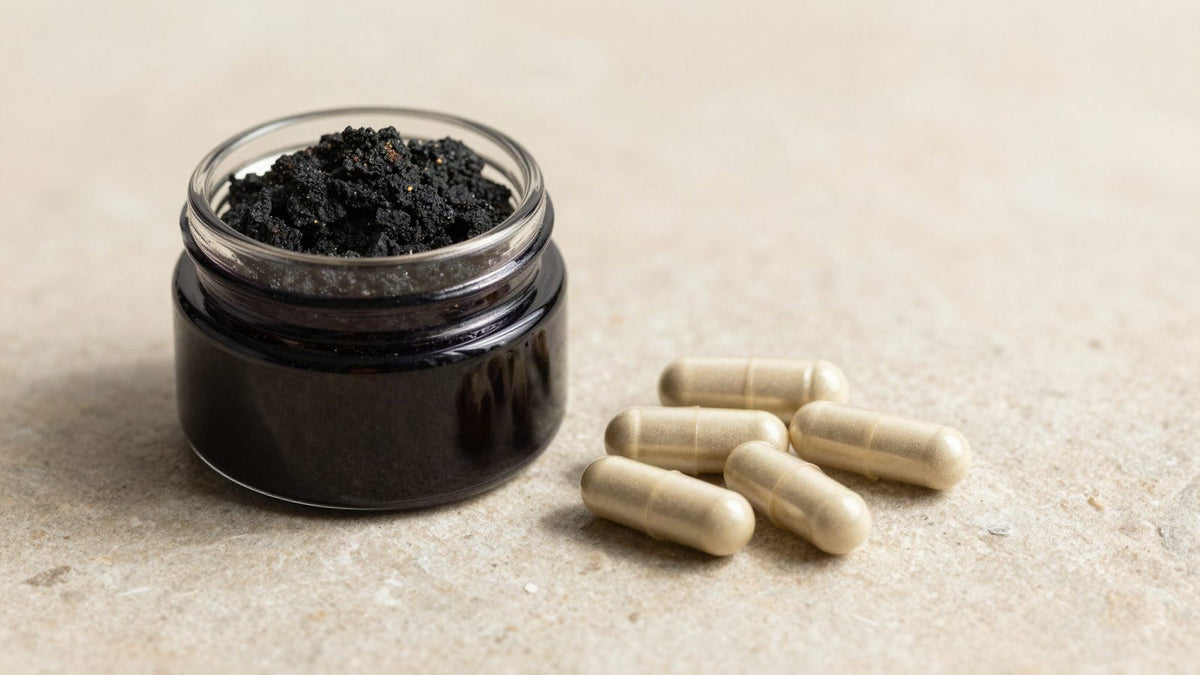
Shilajit resin and shilajit capsules are two forms of the same mineral-rich substance, and we found no human study that compared them. Most trials cited here used capsules, two of them of a purified extract standardized for fulvic acid; the one resin trial was a small pilot without a placebo group, and its authors say comparative trials are needed [1][2][3][12].
Key facts
- In a 2019 trial, 63 young men took one capsule a day of a purified shilajit extract standardized to at least 50% fulvic acid, at 250 or 500 mg, for 8 weeks [1].
- In a 2026 open-label pilot, 25 men took 250 mg of resin twice a day in warm water; the authors, four of six employed by the maker, wrote that most prior trials used purified extracts [3].
- The capsules in a 2019 trial in women also held gelatin, microcrystalline cellulose and other standard excipients [2].
- A 2025 lab study found thallium, a toxic metal, in natural shilajit and in supplements, sometimes at higher levels in the supplements [5].
What is the difference between shilajit resin and capsules?
Shilajit resin is the sticky, tar-like form, described as coming from mountain rock [4], while capsules hold a dried extract plus the capsule's own ingredients [2]. Two details blur the line. The resin in the 2026 pilot was itself an aqueous extract, standardized to at least 60% fulvic acids [3]. And the capsule extracts in the trials were standardized too, to at least 50% or 60% fulvic acid [1][2]. So "resin" and "capsule" describe texture and packaging more than what is inside. The amount and the standardization tell you more.
| Form | What it is | Used in the human trials cited here | What to look for |
|---|---|---|---|
| Resin | Sticky, tar-like material, dissolved in warm water in the one trial [3][4] | One open-label pilot: 25 men, 500 mg a day, 28 days [3] | Amount per serving, fulvic acid %, metal results |
| Capsule | Extract powder plus excipients [2] | Most trials: 100 to 500 mg per capsule, once or twice a day [1][2][12] | Amount per capsule, other ingredients |
| Loose powder | Dried extract without a capsule | No trial cited here | Amount per scoop, standardization |
| Gummy | Shilajit in a chewable base | No trial cited here | Sugars on the panel [9], amount per gummy |
| MOODLY strip | A thin film that melts on the tongue: 50 mg | Not studied | Contains: Shellfish (Oyster peptide) |
Is shilajit resin or capsules better?
Neither form has been shown better in people: we found no human study that compared resin, capsules, powder or gummies. The authors of the resin pilot say so themselves: "comparative trials versus standardized extracts are required" [3]. Their study had no placebo group, which limits what it can show [3]. Processing does not settle quality either. In a 2025 analysis, some supplements held more thallium than crude shilajit [5]. What separates two products is the dose per serving, the fulvic acid standardization and the metal results, not the texture. How to read those numbers: how to tell if shilajit is real and does shilajit have heavy metals?
Shilajit resin vs gummies
Shilajit gummies have no trial behind them among the studies cited here. FDA lists gummies among the forms supplements come in, next to capsules, powders and liquids [8]. Two things to check on a gummy: the shilajit amount per gummy, and the sugars, which must appear on the Supplement Facts panel when present [9].
Shilajit resin vs powder
Shilajit powder is a dried extract, and like any form it varies with its origin [6][7]. A 2025 review says shilajit's chemical composition "is not known with certainty" and varies by region, with more than 80% of it by mass made of humic substances [6]. A 2024 study describes "low uniformity of Shilajit quality" [7]. A standardized powder states a fulvic acid percentage; an unstandardized one may not.
What to check on any form
- The amount per serving, on the Supplement Facts panel [8]. Compare it with the 200 mg to 1,000 mg a day used in most trials (how to take shilajit).
- No blend total in place of the shilajit amount. A label may list only the total amount of a proprietary blend [10].
- A certificate of analysis that gives the test methods, limits and actual results, not just "pass" [11].
Where MOODLY fits

MOODLY makes supplement strips that melt on your tongue, one mood per tin, so the strip is a fifth form: a thin film you place on your tongue. MOODLY Libido Strips hold 50 mg of shilajit, 50 mg of Cordyceps militaris and 20 mg of oyster peptide per strip, chocolate flavor, zero sugar. Contains: Shellfish (Oyster peptide). That 50 mg is a fifth of a single 250 mg capsule, and no study has tested this strip.
Related reading
- How Do You Take Shilajit?
- How to tell if shilajit is real
- Shilajit: what it is, how much is in a MOODLY strip, what studies used
- Libido strips: what they are and what's in them
Sources
- Keller JL et al., Journal of the International Society of Sports Nutrition, 2019. PubMed PMID 30728074. PMC6364418
- Das A et al., Journal of the American College of Nutrition, 2019. PubMed PMID 31161927. PMC7027386
- Yadav D et al., Cureus, 2026. PubMed PMID 41613504. PMC12848467
- Kohli HK et al., Journal of Chromatography A, 2026. PubMed PMID 41330163
- Kamgar E et al., BMC Chemistry, 2025. PubMed PMID 39827344
- Kamgar E, Kaykhaii M, Zembrzuska J, Critical Reviews in Analytical Chemistry, 2025. PubMed PMID 38133965
- Ding R et al., Frontiers in Pharmacology, 2024. PubMed PMID 39624838
- U.S. Food and Drug Administration, FDA 101: Dietary Supplements. fda.gov
- US Code of Federal Regulations, 21 CFR 101.36 and 101.9. ecfr.gov
- US Code of Federal Regulations, 21 CFR 101.36(c)(3), proprietary blends. ecfr.gov
- US Code of Federal Regulations, 21 CFR 111.75. ecfr.gov
- Biswas TK et al., Andrologia, 2010. PubMed PMID 20078516; Sadeghi SMH et al., Journal of Alternative and Complementary Medicine, 2020. PubMed PMID 32310691
*These statements have not been evaluated by the Food and Drug Administration. This product is not intended to diagnose, treat, cure, or prevent any disease.


