







By Alvyn Detavernier, founder of MOODLY · Updated November 2026
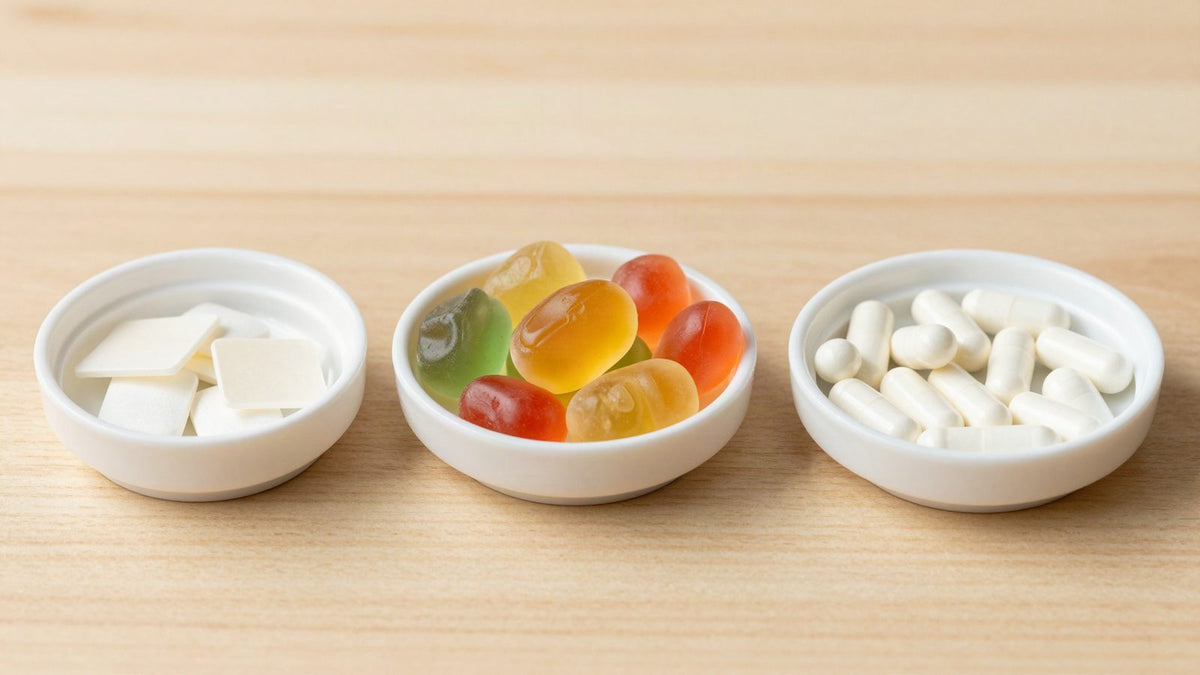
There is no best supplement format in general: strips, gummies and pills each win on something you can check, such as what you have to swallow, sugar, how much one serving can carry, cost and portability. Which one gets more of an ingredient into your blood depends on the ingredient and the product, so the table sticks to what you can check.
We make strips, so every cell below is sourced or checkable on the product.
The comparison at a glance
| Strips | Gummies | Pills and capsules | |
|---|---|---|---|
| Water needed | No. Saliva softens the film [1] | No, you chew them | Usually taken with a drink |
| Something to swallow whole | No. It melts, then you swallow it with saliva [2] | No, you chew them | Yes; many adults find it hard [3][4] |
| Sugar | Check the panel. MOODLY strips: zero sugar [5] | Check "Total sugars" [6] | Check the panel [6] |
| How much one serving can carry | Small: tens of milligrams [2][7][8] | More room than a strip; check the label | Usually the most. Films are not suited to large doses [1] |
| Range of ingredients | Limited [1][8] | Wider; check the label | Usually the widest |
| Cost per dose | Often higher; films cost more to develop [1] | Varies by product | Often the lowest |
| Portability | MOODLY strips: wrapped one by one. Films pick up moisture [1] | Check the packaging | Check the packaging |
| Taste | Flavored; you taste it while it melts [7] | Flavored | Usually none if swallowed whole |
For all three, look for each ingredient with its own amount: some labels show only a "proprietary blend" total [6]. There is no uptake row, on purpose.
Strips: strengths and trade-offs
A strip is a thin, flexible film that softens on your tongue, so you take it without water and without swallowing anything whole [7][1]. MOODLY strips have zero sugar [5] and are sealed one by one, because films pick up moisture [1].
A strip is tiny, so it can only carry a small amount of each ingredient, and low loading capacity is a known limit of films [7][8]. Strips also cost more to develop than plain tablets [1], which is one reason a strip often costs more per dose.
Gummies: strengths and trade-offs
Gummies are familiar, and a gummy is bigger than a strip, so it usually has room for more of an ingredient.
Check two things. The sugar line: sugars must be listed on the Supplement Facts panel when a serving has 0.5 g or more [6]. And label accuracy. A 2023 lab analysis of 25 melatonin gummy products sold in the US found that 22 did not contain an amount within 10% of the label [9]. It tested only melatonin gummies, one sample per brand. The authors do not know whether the results apply to tablets and capsules [9]. We found no test of this kind for strips. MOODLY has not published lab certificates for its strips yet, so we make no accuracy claim either.
Pills and capsules: strengths and trade-offs
Pills offer the widest range of ingredients and doses: a capsule or a powder holds far more than a strip ever will [1][2]. Pills usually cost the least per dose, and a capsule swallowed whole has little taste.
What they give up is the swallow. In a survey of 1,051 primary care patients in Germany, 37% said they had had trouble swallowing tablets or capsules at some point [3]. FDA guidance, citing a national survey, suggests the problem may affect as many as 40 percent of Americans [4].
What about uptake?
Once a film melts, what it carried is swallowed with saliva [2]; uptake through the lining of the mouth, described for some drug films [1], depends on the molecule [7].
Head-to-head studies exist for a few ingredients and do not all point the same way. When a vitamin D3 film was compared with a liquid form in 48 healthy adults, blood levels were very similar, with no statistically significant difference; the authors described the film's result as slightly higher [8]. The film's maker funded the study, and it did not test a MOODLY strip. In healthy adults, a glutathione film showed a trend toward higher blood levels than a tablet [10], and vitamin D3 gummies gave higher blood levels than tablets at the same dose [11]. We found no study comparing a strip with a pill or a gummy for any ingredient we use.
The FTC expects competent and reliable scientific evidence for health claims, and asks whether the product in a study was taken the same way as the one sold [12]. MOODLY has no such study on its strips, so we do not claim a strip does more than any other form.
How to choose
- By dose. For hundreds of milligrams, a pill or powder is the better tool. Strips suit small amounts.
- By what you will take every day. Pills usually cost less per dose. A strip may be easier to keep taking if swallowing is what stops you.
- By sugar. Read "Total sugars" on any panel [6].
- By place. At a desk or on a plane, no-water formats travel well.
Talk with a health care professional before starting a supplement, especially if you take medication [13].
Where MOODLY fits

MOODLY makes five strips, one mood each, with every amount printed on the tin. A MOODLY Sleep Strip contains melatonin 1 mg, valerian root extract 50 mg, lavender extract 20 mg, chamomile extract 10 mg and hibiscus extract 10 mg. One study in 20 healthy men tested 0.1 to 10 mg of melatonin, taken at midday [14]; 1 mg sits inside that range. Valerian is light: NIH notes it has been used in doses of 300 to 600 mg a day for up to 6 weeks [15]. The strip supports healthy sleep cycles*. One strip a day at most, adults 18+, not for use during pregnancy or nursing [16].
Read more: What are oral strips?, Do oral strips work?, Melatonin strips vs gummies.
FAQ
Are pills or gummies better?
It depends on what you need. Pills usually cost less per dose and carry larger amounts. Gummies suit people who dislike swallowing pills; check the sugar line [6].
B12 strips vs pills: which is better?
We searched PubMed and found no human study comparing a vitamin B12 strip with a B12 tablet, so we cannot say either gets more B12 into your blood. Compare the amount per serving, sugar and cost. MOODLY does not sell a B12 strip.
Do strips have sugar?
Some may, so check the panel. MOODLY strips have zero sugar: under FDA rules, less than 0.5 g of sugars per serving, among other conditions [5]. Stevia, monk fruit or sugar alcohols sweeten them, depending on the strip, all listed on the tin.
Can a strip replace my multivitamin?
No. A multivitamin combines many nutrients in one serving, more than the tens of milligrams a strip can hold [1][2][8].
Sources
- Salawi A, Pharmaceuticals (Basel), 2022. PubMed PMID 35890143. https://pmc.ncbi.nlm.nih.gov/articles/PMC9323338/
- Visser JC et al., Int J Clin Pharm, 2020. PubMed PMID 32052239. https://pmc.ncbi.nlm.nih.gov/articles/PMC7192866/
- Schiele JT et al., Eur J Clin Pharmacol, 2013. PubMed PMID 23052416. https://pubmed.ncbi.nlm.nih.gov/23052416/
- FDA, Size, Shape, and Other Physical Attributes of Generic Tablets and Capsules, Guidance for Industry, 2022. https://www.fda.gov/media/161902/download
- 21 CFR 101.60(c), "zero sugar" and related terms. https://www.ecfr.gov/current/title-21/section-101.60
- 21 CFR 101.36, Supplement Facts labeling (sugars, proprietary blends), and 21 CFR 101.9(c)(6)(ii). https://www.ecfr.gov/current/title-21/section-101.36 and https://www.ecfr.gov/current/title-21/section-101.9
- Sevinç Özakar R, Özakar E, Turk J Pharm Sci, 2021. PubMed PMID 33634686. https://pmc.ncbi.nlm.nih.gov/articles/PMC7957312/
- Radicioni M et al., Clin Drug Investig, 2022. PubMed PMID 35034345. https://pmc.ncbi.nlm.nih.gov/articles/PMC8761109/
- Cohen PA et al., JAMA, 2023. PubMed PMID 37097362. https://pmc.ncbi.nlm.nih.gov/articles/PMC10130950/
- Jung ES et al., Eur J Pharm Biopharm, 2026. PubMed PMID 42392376. https://pubmed.ncbi.nlm.nih.gov/42392376/
- Wagner CL et al., Nutrients, 2019. PubMed PMID 31067745. https://pubmed.ncbi.nlm.nih.gov/31067745/
- Federal Trade Commission, Health Products Compliance Guidance, 2022. https://www.ftc.gov/business-guidance/resources/health-products-compliance-guidance
- FDA, FDA 101: Dietary Supplements. https://www.fda.gov/consumers/consumer-updates/fda-101-dietary-supplements
- Dollins AB et al., Proc Natl Acad Sci USA, 1994. PubMed PMID 8127888. https://pubmed.ncbi.nlm.nih.gov/8127888/
- NIH, National Center for Complementary and Integrative Health, Valerian. https://www.nccih.nih.gov/health/valerian
- NIH, National Center for Complementary and Integrative Health, Using Dietary Supplements Wisely. https://www.nccih.nih.gov/health/using-dietary-supplements-wisely
*These statements have not been evaluated by the Food and Drug Administration. This product is not intended to diagnose, treat, cure, or prevent any disease.


