







By Alvyn Detavernier, founder of MOODLY · Updated November 2026
Molybdenum glycinate is a supplement form of molybdenum, a trace mineral, which NIH's PubChem database lists as molybdenum combined with glycine, the simplest protein-building amino acid [1][2]. NIH names it among the forms used in supplements and notes that no studies have compared how well those forms are taken up [3]. MOODLY Slim Strips list 10 mcg of molybdenum per strip.
Key facts
- The body uses molybdenum to build molybdopterin, a cofactor needed by four enzymes, including sulfite oxidase and xanthine oxidase [3].
- The RDA for adult men and women is 45 mcg of molybdenum a day, and the upper limit is 2,000 mcg a day [4].
- A 1984 FDA study of foods eaten in the United States estimated average daily molybdenum intakes from food at 109 mcg for men and 76 mcg for women [3].
- NIH reports that molybdenum deficiency has not been seen except in people with a rare genetic mutation [3].
What is molybdenum glycinate, exactly?
Molybdenum glycinate is molybdenum paired with glycine: PubChem's record names it "tetrakis(2-aminoacetic acid);molybdenum", that is, molybdenum with four molecules of glycine [1]. Glycine is the simplest amino acid the body uses to build proteins, and "glycinate" is the chemical name of glycine's conjugate base [2]. Supplements also use molybdenum chloride, sodium molybdate and "molybdenum amino acid chelate" [3].
Is one form better? NIH says plainly that no studies have compared how well molybdenum from these different forms is taken up [3]. We found no published human study of molybdenum glycinate itself.
What is a molybdenum supplement used for?
Molybdenum's job in the body is to help four enzymes work. They break down sulfur-containing amino acids and compounds called purines, and three of them also help process drugs and toxins [3]. Molybdenum is sold alone, with other minerals, or in multivitamins, at about 50 to 500 mcg per product [3]. A strip of MOODLY Slim Strips sits well below that range, at 10 mcg [5].
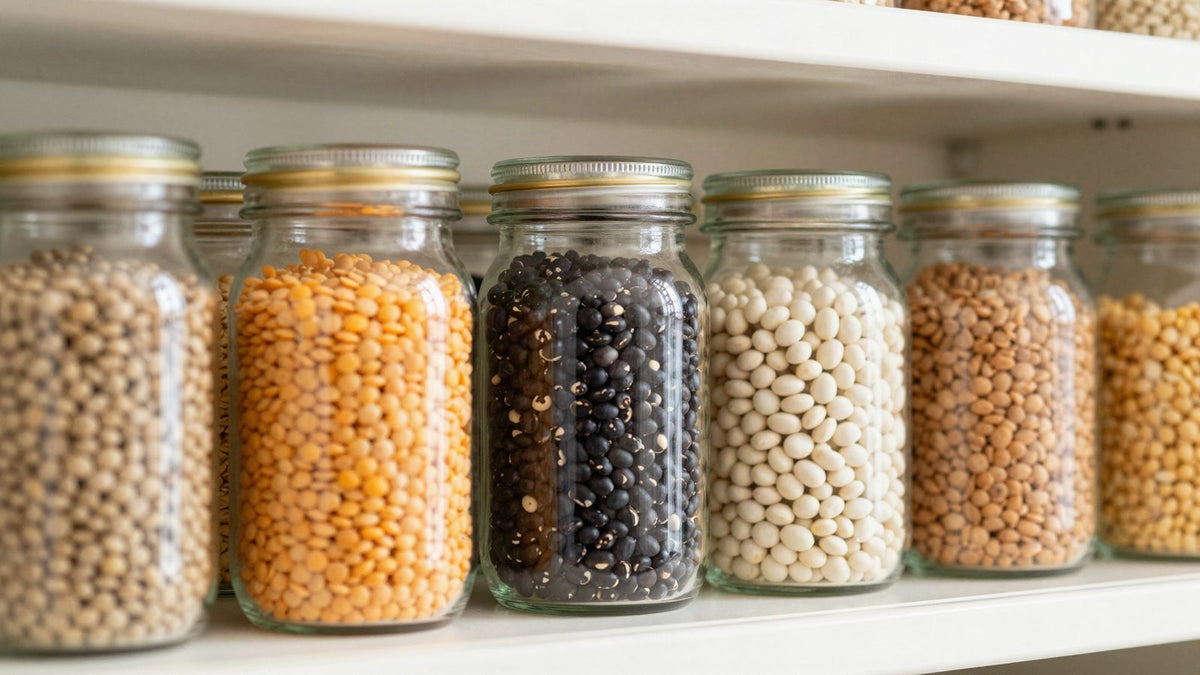
Legumes are the richest food source; half a cup of boiled black-eyed peas holds about 288 mcg, more than six times the Daily Value. Whole grains, nuts and beef liver are also high [3].
| Amount of molybdenum a day | What it is | Source |
|---|---|---|
| 10 mcg (22% DV) | One strip of MOODLY Slim Strips | [5] |
| 45 mcg | RDA for adults, and the Daily Value on labels | [4][5] |
| 50 to 500 mcg | Range in molybdenum supplements | [3] |
| 76 (women) to 109 mcg (men) | Average intake from food, FDA estimate from 1984 | [3] |
| 288 mcg | Half a cup of boiled black-eyed peas | [3] |
| 2,000 mcg | Upper limit for adults | [4] |
| 10,000 to 15,000 mcg | Daily intake from food in a high-molybdenum area of Armenia | [3] |
Is molybdenum supplementation necessary?
For most people, NIH's figures suggest food already covers molybdenum needs: "Most Americans appear to consume adequate amounts," and "no known groups of people are likely to have inadequate molybdenum intakes" [3]. Deficiency has been reported only with a rare genetic mutation that blocks the body from making molybdopterin [3].
What are the side effects of molybdenum supplements?
Molybdenum side effects are uncommon in the sources cited here: NIH says acute toxicity is rare, and that in healthy people, eating foods high in molybdenum usually poses no risk because the excess "is rapidly excreted in urine" [3]. In an area of Armenia where the soil is very high in molybdenum, people taking in 10 to 15 mg a day from food had joint aches and high uric acid in the blood [3]. The upper limit of 2,000 mcg a day was set from animal data, because human studies were lacking [3][4]. NIH lists no known, clinically relevant interactions with medicines [3].
How do you read "molybdenum (as molybdenum glycinate)" on a label?
On a Supplement Facts panel, the amount listed is the nutrient itself, not the compound that carries it, and that source compound may follow in parentheses after "as" [6]. The MOODLY Slim Strips panel lists "Molybdenum (as Molybdenum Glycinate 400 mcg)" at 10 mcg, 22% of the Daily Value of 45 mcg [5]. So each strip contains 10 mcg of molybdenum, carried by 400 mcg of the glycinate ingredient. The chromium line on the same panel follows the same rule: see chromium picolinate side effects. More label basics: how to read a supplement facts label.
Where MOODLY fits

MOODLY makes supplement strips that melt on your tongue, one mood per tin. MOODLY Slim Strips contain 10 mcg of molybdenum (22% DV) alongside 10 mg of saffron (Crocus sativus) and 75 mcg of chromium. Molybdenum is there as a trace mineral, not as a snacking ingredient: we found no study of molybdenum and snacking or cravings. The snacking research on saffron and chromium is in saffron for appetite: what studies show, and every MOODLY ingredient is listed on our ingredients page.
Related reading
- What Are the Side Effects of Chromium Picolinate?
- How to read a supplement facts label
- MOODLY ingredients: every amount in every strip
- Saffron for appetite: what studies show
Sources
- NIH National Library of Medicine, PubChem, Molybdenum Glycinate (CID 140437129). https://pubchem.ncbi.nlm.nih.gov/compound/140437129
- NIH National Library of Medicine, PubChem, Glycine (CID 750). https://pubchem.ncbi.nlm.nih.gov/compound/750
- NIH Office of Dietary Supplements, Molybdenum: Fact Sheet for Health Professionals. https://ods.od.nih.gov/factsheets/Molybdenum-HealthProfessional/
- Institute of Medicine, Dietary Reference Intakes for Vitamin A, Vitamin K, Arsenic, Boron, Chromium, Copper, Iodine, Iron, Manganese, Molybdenum, Nickel, Silicon, Vanadium, and Zinc, 2001, chapter 11. https://nap.nationalacademies.org/read/10026/chapter/13
- Code of Federal Regulations, 21 CFR 101.9(c)(8)(iv), Daily Values. https://www.ecfr.gov/current/title-21/chapter-I/subchapter-B/part-101/subpart-A/section-101.9
- Code of Federal Regulations, 21 CFR 101.36(b)(2)(ii) and (d), Nutrition labeling of dietary supplements. https://www.ecfr.gov/current/title-21/chapter-I/subchapter-B/part-101/subpart-C/section-101.36
*These statements have not been evaluated by the Food and Drug Administration. This product is not intended to diagnose, treat, cure, or prevent any disease.


