







By Alvyn Detavernier, founder of MOODLY · Updated November 2026
In the trials cited here, lion's mane and cordyceps preparations taken for weeks were generally well tolerated: a few people stopped for stomach discomfort, nausea or a rash [2], and other trials reported no adverse events or none beyond placebo [6][7][9]. Long-term data are limited, product quality varies [16], and some people should ask a doctor first.
Key facts
- A 2025 systematic review lists stomach discomfort, headache and allergic reactions as potential side effects of lion's mane [1].
- In a 49-week trial of 1,050 mg of lion's mane mycelium a day in older adults in a clinical population, four people dropped out for stomach discomfort, nausea or a skin rash [2].
- In 79 healthy men, 1.5 g of Cordyceps militaris a day for 4 weeks showed no statistically significant adverse reaction [7].
- NIH's National Cancer Institute notes that FDA does not regularly review how supplements are made, so batches and brands of mushroom supplements may not be the same [16].
What do "extract", "powder", "fruiting body" and "mycelium" mean?
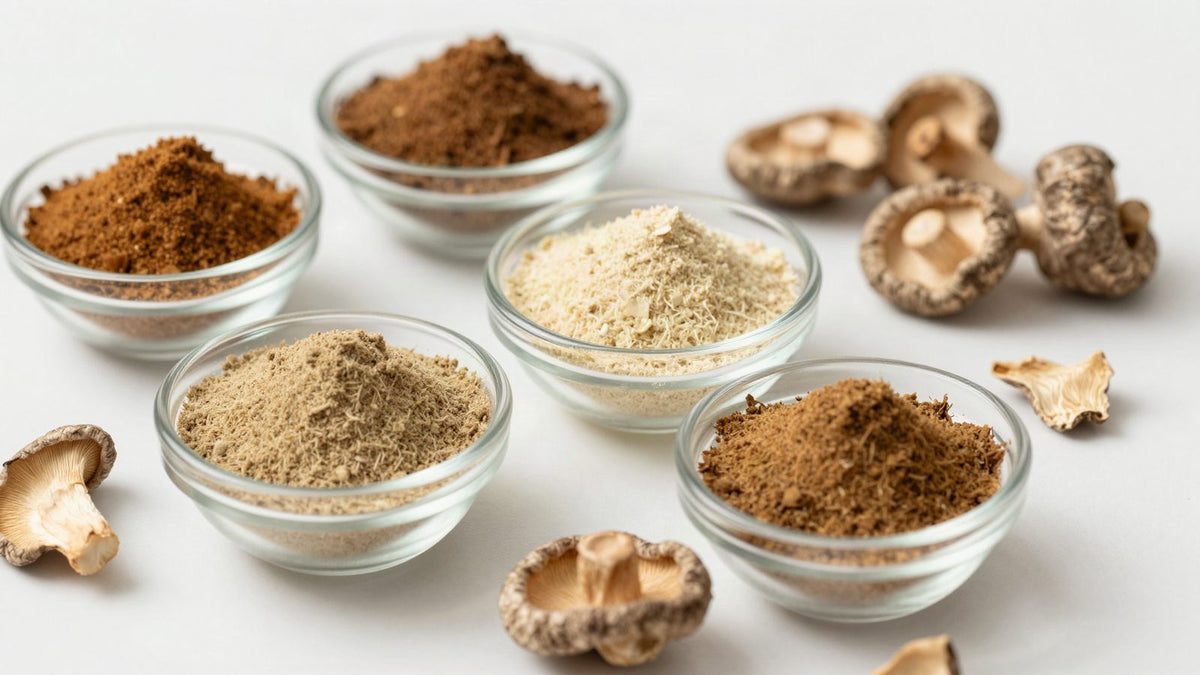
Mushroom supplements are often "extract preparations" made from one life stage of the fungus: the fruiting body or the mycelium [3]. Their makeup can vary with where they are grown and how they are processed [3]. An extract may carry a ratio: one trial used a "10:1 extract" of lion's mane fruiting body [4]. Labels use these words; ask the maker which part is used, whether it is an extract or a powder, and at what ratio.
What side effects were reported, by mushroom?
| Mushroom | Amount and duration | Who | What was reported |
|---|---|---|---|
| Lion's mane | Review of trials and lab studies | Mixed groups | Stomach discomfort, headache, allergic reactions [1] |
| Lion's mane | 1,050 mg of mycelium a day, 49 weeks | Older adults, clinical population | Four dropouts: stomach discomfort, nausea, skin rash [2] |
| Cordyceps (C. sinensis, Cs-4) | About 1 g a day, 12 weeks | 20 healthy adults aged 50 to 75 | "No adverse events occurred" [5][6] |
| Cordyceps (C. militaris) | 1.5 g a day, 4 weeks | 79 healthy men | No statistically significant adverse reaction [7] |
| Cordyceps (C. militaris) | Drink with 2.85 mg of cordycepin, 8 weeks | 40 healthy adults | Safety lab values did not differ from placebo [8] |
| Cordyceps (C. militaris) | 3 g a day, 6 weeks | Clinical population | Adverse events no more frequent than placebo [9] |
| Shiitake | Whole mushrooms, mostly raw or undercooked | Published cases | A rare skin rash [10]; a 2026 letter in a dermatology journal links it to a mushroom coffee [11] |
| Maitake | An extract, with a prescription blood thinner | One case | A rise in a blood-clotting test [12] |
Case reports add to this for cordyceps: prolonged bleeding after dental surgery in a daily C. sinensis user [13], one liver reaction that resolved when an herbal supplement containing C. sinensis was stopped [14], and one report of stomach bleeding when C. sinensis was taken with a prescription drug [15]. Case reports show what can happen, not how often.
How much is known about long-term use?
Not much. The longest trial cited here lasted 49 weeks, in older patients [2]. The cordyceps trials in healthy adults cited here lasted 4 to 12 weeks [5][7][8]. Toxicology assessments, especially of whole mushroom powders, "remain limited" [3]. Daily use of lion's mane in trials: Can you take lion's mane every day?
What do FDA and NIH say about mushroom supplements?
- FDA does not approve dietary supplements for safety and effectiveness before they are sold [17].
- NIH's National Cancer Institute: batches and brands of mushroom supplements "may not be the same" [16].
- NIH's NCCIH: "natural" does not always mean "safe" [18].
In a DNA test of 19 mushroom supplements sold in Italy, 6 could be matched to the labeled species [19].
Who should ask a doctor first?
- You take medication, especially a blood thinner. Some supplements interact with medications or have dangerous effects during surgery [17][12][13]. Tell your dentist or surgeon.
- You are pregnant or nursing. Many supplements have not been tested in pregnant women or nursing mothers [18].
- You are under 18. A 2026 case report describes a serious reaction in a 9-year-old who had other health conditions, after supplements containing reishi and cordyceps [21].
- You have a known mushroom allergy. Allergic reactions and skin rashes are among the reports above [1][10].
What should you look for on the label?
A Supplement Facts panel listing each dietary ingredient and its amount [17]; each mushroom named in Latin, with its own amount rather than a "proprietary blend", which federal rules allow to show only a total [20]; and the part used. More in Can lion's mane get you high?
What do lion's mane reviews say?
Cautious. A 2025 systematic review lists the side effects above [1], and a 2024 review called the results of 10 mushroom intervention studies "mixed"; most tested lion's mane, with some gains in mood and thinking reported in middle-aged and older adults [22]. MOODLY launched in 2026, and this page quotes no rating and no review count.
Where does MOODLY stand?
A MOODLY Focus Strip holds 100 mg of mushrooms: lion's mane 30 mg, maitake 25 mg, cordyceps (C. sinensis) 25 mg and shiitake 20 mg. One strip a day at most, adults 18 and over, not during pregnancy or nursing. Trial amounts are far higher: 1,050 mg of lion's mane is 35 times a strip [2], about 1 g of cordyceps 40 times [5]. So trial tolerance data are not data about the strip either, and no study has tested it.
Our supplier has not yet confirmed whether each mushroom is an extract or a powder, fruiting body or mycelium, and MOODLY has not published a lab certificate. Study amounts: lion's mane, cordyceps, the mushroom focus strips guide and Cordyceps vs lion's mane.

Sources
- Menon A et al., Frontiers in Nutrition, 2025. PubMed PMID 40959699. https://pubmed.ncbi.nlm.nih.gov/40959699/
- Li IC et al., Frontiers in Aging Neuroscience, 2020. PubMed PMID 32581767. https://pubmed.ncbi.nlm.nih.gov/32581767/
- Mahadevan K et al., Frontiers in Toxicology, 2025. PubMed PMID 41230556. https://pubmed.ncbi.nlm.nih.gov/41230556/
- Surendran G et al., Frontiers in Nutrition, 2025. PubMed PMID 40276537. https://pubmed.ncbi.nlm.nih.gov/40276537/
- Chen S et al., Journal of Alternative and Complementary Medicine, 2010. PubMed PMID 20804368. https://pubmed.ncbi.nlm.nih.gov/20804368/
- Chen S et al., Journal of Alternative and Complementary Medicine, 2010 (full text). PubMed PMID 20804368. https://pmc.ncbi.nlm.nih.gov/articles/PMC3110835/
- Kang HJ et al., Journal of Medicinal Food, 2015. PubMed PMID 26284906. https://pubmed.ncbi.nlm.nih.gov/26284906/
- Ontawong A et al., Scientific Reports, 2024. PubMed PMID 38580687. https://pubmed.ncbi.nlm.nih.gov/38580687/
- Zhou J et al., 2021. PubMed PMID 34858228. https://pmc.ncbi.nlm.nih.gov/articles/PMC8632006/
- Nguyen AH et al., International Journal of Dermatology, 2017. PubMed PMID 28054338. https://pubmed.ncbi.nlm.nih.gov/28054338/
- Mijares J, Ramachandran V, International Journal of Dermatology, 2026. PubMed PMID 42231050. https://pubmed.ncbi.nlm.nih.gov/42231050/
- Hanselin MR et al., Annals of Pharmacotherapy, 2010. PubMed PMID 20040699. https://pubmed.ncbi.nlm.nih.gov/20040699/
- Hatton MN et al., Oral Surgery, Oral Medicine, Oral Pathology and Oral Radiology, 2018. PubMed PMID 30195658. https://pubmed.ncbi.nlm.nih.gov/30195658/
- Thurian D et al., International Journal of Clinical Pharmacology and Therapeutics, 2022. PubMed PMID 34889735. https://pubmed.ncbi.nlm.nih.gov/34889735/
- Siwek M et al., Frontiers in Pharmacology, 2023. PubMed PMID 37829299. https://pubmed.ncbi.nlm.nih.gov/37829299/
- National Cancer Institute (NIH), Medicinal Mushrooms (PDQ), Patient Version. https://www.cancer.gov/about-cancer/treatment/cam/patient/mushrooms-pdq
- U.S. Food and Drug Administration, FDA 101: Dietary Supplements. https://www.fda.gov/consumers/consumer-updates/fda-101-dietary-supplements
- National Center for Complementary and Integrative Health (NIH), Using Dietary Supplements Wisely. https://www.nccih.nih.gov/health/using-dietary-supplements-wisely
- Risoli S et al., Nutrients, 2023. PubMed PMID 36771482. https://pubmed.ncbi.nlm.nih.gov/36771482/
- Code of Federal Regulations, 21 CFR 101.36, Nutrition labeling of dietary supplements. https://www.ecfr.gov/current/title-21/section-101.36
- Melek Arsoy HE, Özdemir Ö, BMC Complementary Medicine and Therapies, 2026. PubMed PMID 42063068. https://pubmed.ncbi.nlm.nih.gov/42063068/
- Cha S et al., Neuroscience and Biobehavioral Reviews, 2024. PubMed PMID 38246232. https://pubmed.ncbi.nlm.nih.gov/38246232/
*These statements have not been evaluated by the Food and Drug Administration. This product is not intended to diagnose, treat, cure, or prevent any disease.


