







By Alvyn Detavernier, founder of MOODLY · Updated November 2026
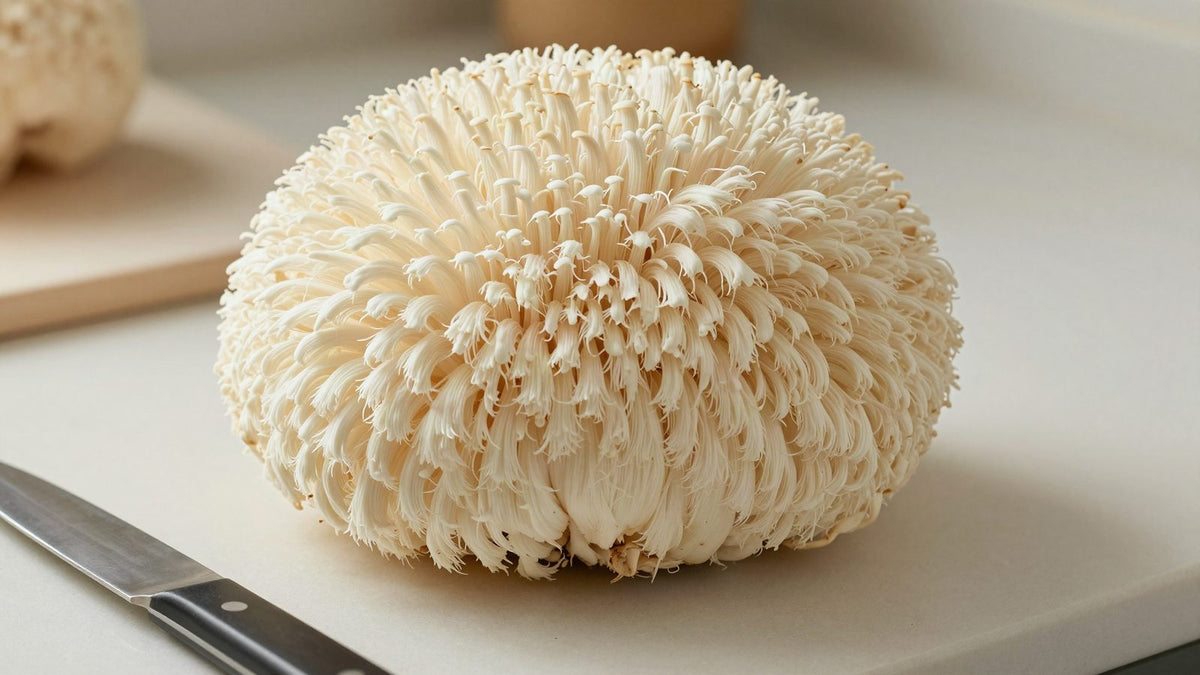
Not according to the research we found. Lion's mane is a culinary mushroom, and the compounds studied in it are erinacines, hericenones and others [1]. Psilocybin, the psychoactive compound of "magic" mushrooms, is described in other groups, mainly Psilocybe [2][3]. A PubMed search found no report of anyone getting high from lion's mane. The real risk is a mislabeled product.
Key facts
- Lion's mane (Hericium erinaceus) is a culinary mushroom; compounds researchers study in it include erinacines, hericerins and hericenones [1].
- Psilocybin is a naturally occurring psychoactive compound found in the Psilocybe genus; some Inocybe species make it too, and Panaeolus species are reputed to contain it [2][3][4].
- In 2024, CDC counted 180 illnesses in 34 states, 73 of them hospitalized, linked to mushroom-labeled chocolate products [6].
- FDA testing of those recalled bars, cones and gummies found psilocin and a prescription drug in some samples [7].
What is lion's mane, and what is in it?
Lion's mane is a mushroom widely eaten in Asian countries [1]. A 2015 review of its chemistry lists polysaccharides, erinacines, hericerins, hericenones and aroma compounds, among others [1]. The review describes properties reported in the literature; it does not test lion's mane for psilocybin, and no source on this page does. What we can say is which mushrooms are known to make psilocybin, and that lion's mane is not among them.
More on the mushroom itself, and the amounts studies used: our lion's mane page.
Which mushrooms contain psilocybin?
Psilocybin is "a naturally occurring psychoactive alkaloid" found in the Psilocybe genus [2]. Most psilocybin-producing species are Psilocybe, and some Inocybe (fiber cap) species make it as well [3]. Panaeolus species are "reputed" to contain it [4]. Lion's mane, Hericium erinaceus, belongs to none of these groups. Psilocin, a substance present in psychoactive mushrooms, is a Schedule I controlled substance [6][7].
Why do people link lion's mane with getting high?
Because of how some people use it. A survey of people who microdose psilocybin notes that some combine it with lion's mane [5]. In that practice, the psychoactive ingredient is the psilocybin [2]. Lion's mane shows up in the same stack, not in the same chemical family.
Are mushroom strips or mushroom edibles a drug?
It depends entirely on what is inside. A mushroom product labeled as a dietary supplement must carry a Supplement Facts panel, and FDA does not approve supplements before they are sold [11]. The products that sent people to the hospital were different: they were made to be psychoactive [6].
- FDA says Amanita muscaria and its compound muscimol are not authorized in conventional food. They have been used in foods marketed as "psychedelic edibles", "legal psychedelics" or "mushroom edibles", and FDA recommends avoiding them [8].
- In 2024, CDC counted 180 cases in 34 states and 73 hospitalizations linked to mushroom-labeled chocolate products, and pointed to variable ingredients and the absence of standardized testing of finished products [6]. FDA found psilocin and a prescription drug in some samples [7].
- US poison centers recorded 362 exposures to psychoactive mushroom edibles; the researchers describe these products as unregulated, "often with unlisted ingredients" [9].
- A 2026 case report describes hallucinations after a young adult ate a "mushroom" product, and its authors warn about "ambiguous labeling" [10].
None of these reports names lion's mane.
How do you read a mushroom product label?
- Species, in Latin. "Hericium erinaceus", not "mushroom blend". In a DNA test of 19 mushroom supplements sold in Italy, 6 could be matched to the species on the label [13].
- A Supplement Facts panel. FDA requires one on supplements, listing each dietary ingredient and its amount per serving [11].
- An amount for each mushroom. Federal rules allow a "proprietary blend" that shows only a total [12]. You then cannot see how much of each is inside.
- No psychedelic promise. A label promising a trip or a "legal psychedelic" is describing a different kind of product [8].
What side effects were reported in lion's mane trials?
Stomach upset, not a high. A 2025 systematic review lists stomach discomfort, headache and allergic reactions as potential side effects [14]. In a 49-week trial of 1,050 mg of mycelium a day in older adults in a clinical population, four people dropped out for stomach discomfort, nausea or a skin rash [15]. Tolerability by mushroom: Are mushroom extracts safe?
What does a MOODLY Focus Strip list?
Four named mushrooms with their amounts, and no other dietary ingredient. The Supplement Facts panel of MOODLY Focus Strips lists, per strip:
- Hericium erinaceus (lion's mane) 30 mg
- Grifola frondosa (maitake) 25 mg
- Cordyceps sinensis (cordyceps) 25 mg
- Lentinus edodes (shiitake) 20 mg
That is 100 mg of mushroom in total, with no caffeine listed on the label. The other ingredients are pullulan, cellulose, lecithin, chocolate flavor, monk fruit extract, medium-chain triglycerides, xanthan gum and steviol glycosides. MOODLY has not published a lab certificate for these mushrooms, so we claim no testing: what we show you is the label. Lion's mane studies used grams; a strip has 30 mg. It is a 3 pm ritual, not an effect.
How the four compare: our mushroom focus strips guide, cordyceps page and Cordyceps vs lion's mane.

Sources
- Friedman M, Journal of Agricultural and Food Chemistry, 2015. PubMed PMID 26244378. https://pubmed.ncbi.nlm.nih.gov/26244378/
- Ling S et al., CNS Drugs, 2022. PubMed PMID 34791625. https://pubmed.ncbi.nlm.nih.gov/34791625/
- Schäfer T et al., Angewandte Chemie International Edition, 2025. PubMed PMID 40977073. https://pubmed.ncbi.nlm.nih.gov/40977073/
- Strauss D et al., Heliyon, 2023. PubMed PMID 37274634. https://pubmed.ncbi.nlm.nih.gov/37274634/
- Rootman JM et al., Scientific Reports, 2022. PubMed PMID 35773270. https://pubmed.ncbi.nlm.nih.gov/35773270/
- Rumph JT et al. (CDC), MMWR Morbidity and Mortality Weekly Report, 2026. PubMed PMID 41955162. https://pubmed.ncbi.nlm.nih.gov/41955162/
- U.S. Food and Drug Administration, outbreak investigation of recalled mushroom-labeled chocolate bars, cones and gummies (June 2024), update of November 15, 2024. fda.gov
- U.S. Food and Drug Administration, Constituent Update on Amanita muscaria or its constituents in food, December 18, 2024. https://www.fda.gov/food/hfp-constituent-updates/fda-alerts-industry-and-consumers-about-use-amanita-muscaria-or-its-constituents-food
- Jorgenson DM et al., Clinical Toxicology, 2026. PubMed PMID 41493095. https://pubmed.ncbi.nlm.nih.gov/41493095/
- Udoro AJ et al., Cureus, 2026. PubMed PMID 42445624. https://pubmed.ncbi.nlm.nih.gov/42445624/
- U.S. Food and Drug Administration, FDA 101: Dietary Supplements. https://www.fda.gov/consumers/consumer-updates/fda-101-dietary-supplements
- Code of Federal Regulations, 21 CFR 101.36, Nutrition labeling of dietary supplements. https://www.ecfr.gov/current/title-21/section-101.36
- Risoli S et al., Nutrients, 2023. PubMed PMID 36771482. https://pubmed.ncbi.nlm.nih.gov/36771482/
- Menon A et al., Frontiers in Nutrition, 2025. PubMed PMID 40959699. https://pubmed.ncbi.nlm.nih.gov/40959699/
- Li IC et al., Frontiers in Aging Neuroscience, 2020. PubMed PMID 32581767. https://pubmed.ncbi.nlm.nih.gov/32581767/
*These statements have not been evaluated by the Food and Drug Administration. This product is not intended to diagnose, treat, cure, or prevent any disease.


