







By Alvyn Detavernier, founder of MOODLY · Updated November 2026
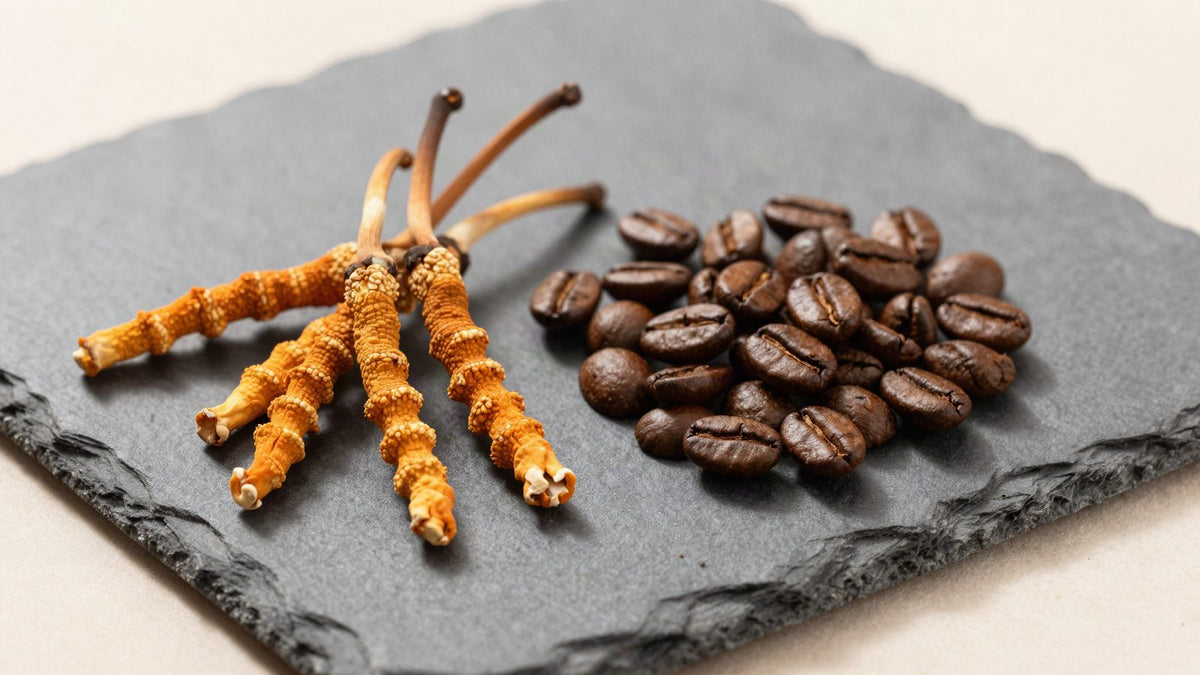
Cordyceps, a group of insect-parasitizing fungi, is not a known source of caffeine: caffeine comes from certain plants, such as coffee, tea, kola nuts and cocoa beans, and we found no study reporting caffeine in cordyceps itself [1][2]. Its best-known compound is cordycepin, a different molecule that resembles adenosine [3][4].
Key facts
- NIH's MedlinePlus says caffeine is found naturally in the leaves, seeds and fruits of more than 60 plants, including tea leaves, kola nuts, coffee and cocoa beans [2].
- Cordycepin (3'-deoxyadenosine) is an adenosine look-alike isolated from Cordyceps militaris and Cordyceps sinensis [3]; PubChem lists it as C10H13N5O3, while caffeine is C8H10N4O2 [4].
- A 2024 paper describes caffeine as a blocker of adenosine receptors [5]; in a rat study, cordycepin increased non-REM sleep, an effect the authors suggest runs through those receptors [3].
- In at least two exercise trials that paired cordyceps with caffeine, the caffeine was its own ingredient, once 200 mg from green tea extract [6][7].
Cordyceps vs caffeine: what is the difference?
Cordyceps is a fungus and caffeine is a single plant compound, so they are not two forms of the same thing [1][2].
| Caffeine | Cordycepin (from cordyceps) | |
|---|---|---|
| What it is | A plant substance and central nervous system stimulant [2] | A compound of cordyceps fungi [3] |
| Found in | Coffee, tea leaves, kola nuts, cocoa beans [2] | C. militaris and C. sinensis [3] |
| Formula | C8H10N4O2, 1,3,7-trimethylxanthine [4][5] | C10H13N5O3, adenosine missing one oxygen [4] |
| Link to adenosine | Blocks adenosine receptors, per a 2024 paper [5] | Resembles adenosine; in rats, increased non-REM sleep [3] |
| Amounts measured | About 95 mg in an 8-ounce cup of brewed coffee [9] | 11.5 mg per gram of cordyceps material in one 2020 analysis [8] |
| FDA reference | 400 mg a day not generally linked to negative effects for most adults [10] |
The rat result is animal data and says nothing about people or about any strip. Its interest here is narrow: caffeine blocks adenosine receptors, while cordycepin resembles adenosine itself, so cordyceps is not a caffeine look-alike in chemistry either.
Does cordyceps coffee have caffeine?
Cordyceps coffee has caffeine because it is coffee: the caffeine comes from the coffee beans, not from the mushroom, and even decaf typically keeps 2 to 15 mg per 8-ounce cup [2][10]. One 2020 study made a cordyceps coffee by processing green coffee beans with mushroom extracts and measured cordycepin, about 2.3 mg per gram of coffee, a fifth of the level in the mushroom material [8]. A 2024 lab analysis simply stirred 2 g of C. militaris powder into 200 mL of coffee [5].
How much caffeine depends on the coffee: MedlinePlus gives 75 to 100 mg per 6-ounce cup [2], and USDA values work out to about 95 mg per 8-ounce cup of brewed coffee [9]. FDA says the body handles caffeine the same way whatever its source, so count every one [10]. For comparison, USDA FoodData Central has no general entry for cordyceps, and for maitake, another functional mushroom, it lists caffeine as assumed zero [11]. More in mushroom coffee vs regular coffee.
Cordyceps and caffeine: can you take them together?
Cordyceps and caffeine have been combined in at least two exercise products tested in trials, but the trials we found used blends, so they cannot show what the cordyceps adds on its own. A 2010 three-week trial gave recreational athletes a pre-workout powder whose blend listed cordyceps sinensis and caffeine side by side, 30 minutes before each session [6]. A 2024 trial in cyclists used a supplement with 200 mg of caffeine from green tea extract plus 2.5 g of a mushroom blend containing C. sinensis [7].
If you combine them yourself, the caffeine is what to count. FDA cites 400 mg a day for most adults, notes wide variation in sensitivity, and says some conditions and medications increase it. Taking a medication, pregnant, trying to become pregnant or breastfeeding? FDA recommends talking to your health care provider about whether to limit caffeine [10]. Cordyceps amounts used in trials, by species, are on our cordyceps page; the two species are compared in cordyceps militaris vs sinensis.
Where MOODLY fits

MOODLY makes supplement strips that melt on your tongue, one mood per tin. MOODLY Focus Strips hold cordyceps (Cordyceps sinensis) 25 mg, with lion's mane 30 mg, maitake 25 mg and shiitake 20 mg. MOODLY Libido Strips hold Cordyceps militaris 50 mg, with shilajit 50 mg and oyster peptide 20 mg; Libido Strips contain shellfish (oyster peptide). Neither label lists caffeine.
Both strips are chocolate flavored, and MedlinePlus lists cocoa beans among caffeine sources [2]. FDA notes that caffeine from chocolate is listed as chocolate, not as caffeine [10]. So we write "no caffeine listed on the label", and we have asked our supplier to confirm the flavor. No study has tested either strip, and we make no promise for either. Caffeine-free options that were actually tested are in caffeine-free focus, and the four Focus mushrooms in our mushroom focus strips guide.
Related reading
- Cordyceps Militaris vs Sinensis: What Is the Difference?
- Mushroom coffee vs regular coffee
- Cordyceps: what it is, how much is in a MOODLY strip, what studies used
- Caffeine-free focus: what has been tested
Sources
- Hoofnagle JH, LiverTox (NIDDK, NIH), Cordyceps, 2026. PubMed PMID 40608959. https://pubmed.ncbi.nlm.nih.gov/40608959/
- MedlinePlus (NIH National Library of Medicine), Medical Encyclopedia article on caffeine. https://medlineplus.gov/ency/article/002445.htm
- Hu Z et al., Evidence-Based Complementary and Alternative Medicine, 2013. PubMed PMID 23710239. https://pubmed.ncbi.nlm.nih.gov/23710239/ (animal study)
- PubChem (NIH National Library of Medicine), Caffeine (CID 2519), Cordycepin (CID 6303), Adenosine (CID 60961). https://pubchem.ncbi.nlm.nih.gov/compound/6303
- Kała K et al., Pharmaceuticals (Basel), 2024. PubMed PMID 39065803. https://pmc.ncbi.nlm.nih.gov/articles/PMC11279603/
- Smith AE et al., Journal of the International Society of Sports Nutrition, 2010. PubMed PMID 20156347. https://pubmed.ncbi.nlm.nih.gov/20156347/
- Nieman DC et al., Frontiers in Nutrition, 2024. PubMed PMID 38873567. https://pubmed.ncbi.nlm.nih.gov/38873567/
- Song HN, 2020. PubMed PMID 32676470. https://pubmed.ncbi.nlm.nih.gov/32676470/
- USDA FoodData Central, Beverages, coffee, brewed, prepared with tap water (FDC ID 171890). https://fdc.nal.usda.gov/food-details/171890/nutrients
- U.S. Food and Drug Administration, Spilling the Beans: How Much Caffeine is Too Much? https://www.fda.gov/consumers/consumer-updates/spilling-beans-how-much-caffeine-too-much
- USDA FoodData Central, Mushrooms, maitake, raw (FDC ID 169403). https://fdc.nal.usda.gov/food-details/169403/nutrients
*These statements have not been evaluated by the Food and Drug Administration. This product is not intended to diagnose, treat, cure, or prevent any disease.


