







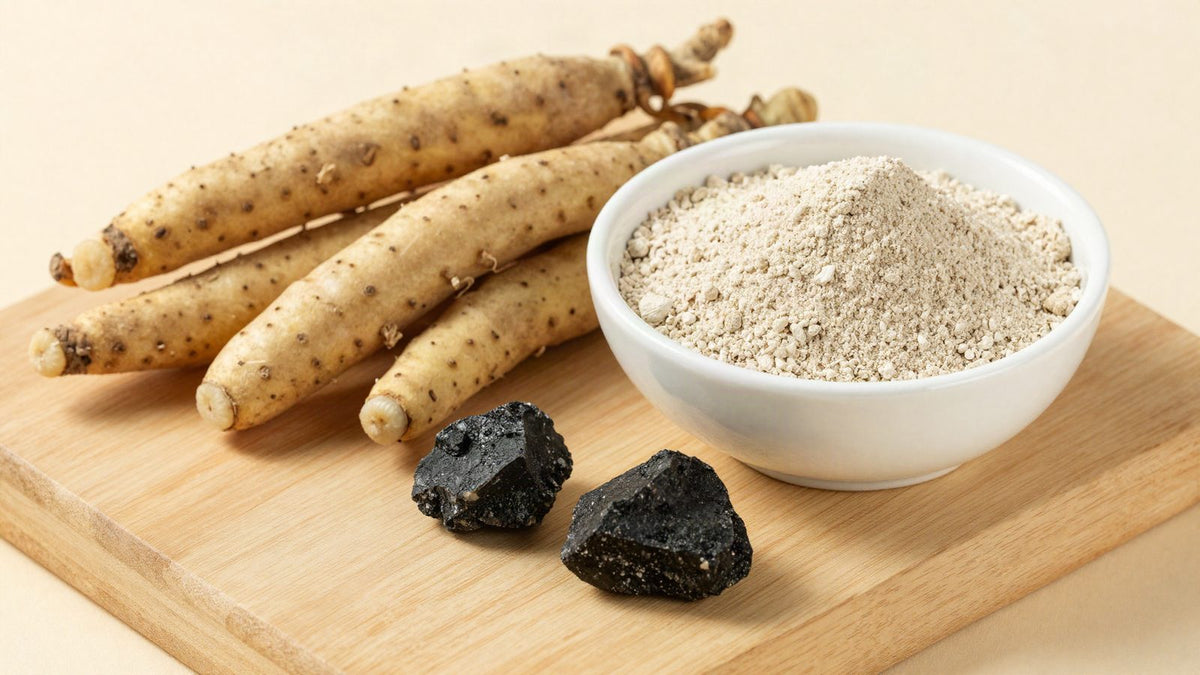
By Alvyn Detavernier, founder of MOODLY · Updated November 2026
Maca is a root of the mustard family grown high in the Peruvian Andes, while shilajit is a brown to black, mineral-rich substance from rock [1][2][5]. We found no study comparing them or testing the pair. Their trials measured different things: maca's included self-rated desire at 1.5 to 3 g a day, shilajit's strength, skin and blood markers [4][5][7].
Key facts
- In a 12-week randomized trial, healthy men aged 21 to 56 took 1,500 mg or 3,000 mg of maca or a placebo; self-reported desire improved from week 8 [4].
- A 2010 systematic review found four randomized trials of maca and judged them too few, too small and of too modest quality to draw firm conclusions [1].
- In a 2019 trial of 63 young men, in the stronger half of the group, 500 mg of shilajit a day differed from placebo on a strength measure over 8 weeks and 250 mg did not [7].
- A 2014 review found relatively few well-controlled human studies of shilajit [9].
Maca root vs shilajit: what each one is
Maca is a food plant and shilajit is a mineral-rich material from rock, so they share little beyond the shelf. The maca root (the hypocotyl) has been eaten for centuries [3]. Shilajit is mostly humic substances plus minerals [6].
| Maca | Shilajit | |
|---|---|---|
| What it is | Root of an Andean plant, mustard family, used as food [1][3] | Organic mineral substance from rock, more than 80% humic substances by mass [5][6] |
| Where it comes from | Grown at 4,000 to 4,500 m (about 13,000 to 14,800 feet) in the Peruvian Central Andes [2] | Rock in almost 20 regions of the world [10] |
| Amounts in the trials cited here | 1.5 to 3 g a day [3][4] | 250 to 1,000 mg a day [5][7][8] |
| What those trials measured | Self-rated desire, mood, energy [3][4] | Strength, skin blood flow, a collagen marker [5][7][8] |
| A known quality issue | Not covered here | Heavy metals in some samples [10] |
| In MOODLY | Not an ingredient | 50 mg per Libido strip |
Maca is sold as powder, capsules, pills, flour and extracts, and it comes in colors from white to black; the 2016 trial tested black and red maca extracts separately [2][3]. Shilajit comes as resin, capsules, powder and gummies (how to take shilajit).
Is maca or shilajit better?
Neither has been shown better than the other: we found no study that compared them. They were studied for different outcomes. For maca, the trials cited here include self-rated desire, and a 2010 review still called that evidence limited [1][4]. For shilajit, we found no study of shilajit alone that measured desire in people, and a 2014 review found relatively few well-controlled human studies of any kind [9]. So "better" depends on what you mean, and the research does not settle it for desire. Timing differs too: in the maca trial the change in desire appeared from week 8 of 12 [4], while the shilajit trials cited here ran 8 to 48 weeks for other outcomes [7][12]. Neither tells you what a different amount, over a few weeks, would do. Shilajit adds a quality question that maca does not share in the sources here: heavy metals in some samples [10]. Before you buy shilajit, read does shilajit have heavy metals?
Can you take maca and shilajit together?
Maca and shilajit taken together have no study of their effects that we could find. The one PubMed record naming both in its title or abstract was a review, not a trial. A 2018 single-dose study gave 12 healthy volunteers two multi-ingredient supplements that listed 5 to 7 mg each of maca and shilajit among more than 20 ingredients, but it measured milk thistle compounds in the blood [13]. Separately, a 12-week trial of 3 g of maca extract a day in 175 adults reported no serious adverse effects, though its senior author manages a nutraceutical company [3]. Shilajit trials cited here lasted up to 48 weeks [12]. None of that tells you how the two behave together. Some supplements interact with medications, and many have not been tested in pregnant or nursing women [11]: ask your pharmacist or doctor before you combine them.
Maca vs shilajit for women and men
Maca and shilajit have both been studied in women, though not much. In the 2010 maca review, one of the four trials was in healthy menopausal women [1]. Shilajit trials in women include 45 healthy women aged 30 to 65 (skin measures) and 60 women after menopause, a clinical population (bone measures) [5][12]. The maca desire trial above was in men [4]. More detail: shilajit for women.
Where MOODLY fits

MOODLY makes supplement strips that melt on your tongue, one mood per tin. MOODLY Libido Strips hold 50 mg of shilajit, 50 mg of Cordyceps militaris and 20 mg of oyster peptide per strip, and no maca. Contains: Shellfish (Oyster peptide). 50 mg of shilajit is a fifth of the smallest daily amount in the shilajit trials above, and no study has tested this strip. More on the ingredient: shilajit.
Related reading
- Is Shilajit Good for Women?
- How to take shilajit
- Shilajit: what it is, how much is in a MOODLY strip, what studies used
- Libido strips: what they are and what's in them
Sources
- Shin BC et al., BMC Complementary and Alternative Medicine, 2010. PubMed PMID 20691074
- Gonzales GF et al., Forschende Komplementarmedizin, 2009. PubMed PMID 20090350
- Gonzales-Arimborgo C et al., Pharmaceuticals (Basel), 2016. PubMed PMID 27548190
- Gonzales GF et al., Andrologia, 2002. PubMed PMID 12472620
- Das A et al., Journal of the American College of Nutrition, 2019. PubMed PMID 31161927
- Kamgar E, Kaykhaii M, Zembrzuska J, Critical Reviews in Analytical Chemistry, 2025. PubMed PMID 38133965
- Keller JL et al., Journal of the International Society of Sports Nutrition, 2019. PubMed PMID 30728074
- Neltner TJ et al., Journal of Dietary Supplements, 2024. PubMed PMID 36546868
- Stohs SJ, Phytotherapy Research, 2014. PubMed PMID 23733436
- Hussain A, Saeed A, Biological Trace Element Research, 2024. PubMed PMID 38393486
- U.S. Food and Drug Administration, FDA 101: Dietary Supplements. fda.gov; NIH National Center for Complementary and Integrative Health, Using Dietary Supplements Wisely. nccih.nih.gov
- Pingali U, Nutalapati C, Phytomedicine, 2022. PubMed PMID 35933897
- Li WY et al., Clinical Therapeutics, 2018. PubMed PMID 29273470. PMC6037411
*These statements have not been evaluated by the Food and Drug Administration. This product is not intended to diagnose, treat, cure, or prevent any disease.


