







By Alvyn Detavernier, founder of MOODLY · Updated November 2026
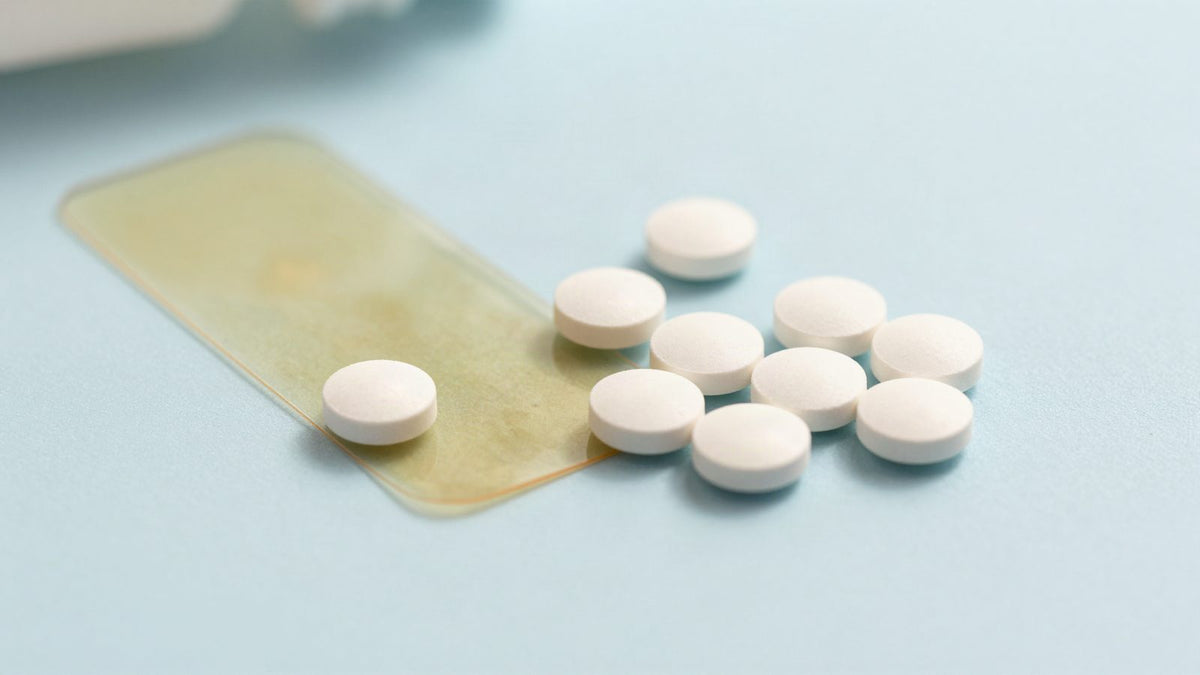
An orally disintegrating tablet (ODT) is a tablet that breaks apart on the tongue within seconds and is then swallowed with saliva, while sublingual is a route that means "beneath the tongue" [1][2][3]. FDA's list of approved drugs files ODTs under the oral route, and sublingual tablets under a route of their own [4].
Key facts
- FDA defines an orally disintegrating tablet as a solid dosage form that disintegrates rapidly, usually within seconds, when placed on the tongue, and recommends an in-vitro disintegration time of about 30 seconds or less [1].
- FDA's drug data standards define the sublingual route as "administration beneath the tongue" and the buccal route as administration directed toward the cheek [2].
- FDA guidance generally recommends that an orally disintegrating tablet weigh no more than 500 mg [1].
- A definition listed in the NCI Thesaurus for FDA's orally disintegrating tablet code says the tablet disperses in saliva "before being swallowed" [3].
What is the difference between oral and sublingual?
The difference between oral and sublingual is where the product is placed and where it goes next. FDA defines the oral route as administration "to or by way of the mouth", and the sublingual route as administration beneath the tongue [2]. An ODT counts as oral: it breaks apart on top of the tongue and you swallow what is left with saliva, so it ends up where a swallowed tablet goes [3][4]. A sublingual product is placed under the tongue and kept there as its label directs. Sublingual products are not only tablets: the Orange Book also lists approved prescription films for use in the cheek or under the tongue [4].
Whether the route changes how much of an ingredient reaches the blood depends on the molecule: its size, its charge, and whether it mixes more readily with oil or with water [7]. For one nutrient, vitamin B12, NIH notes that it is sold as sublingual tablets or lozenges and says evidence suggests no difference between oral and sublingual forms [8]. That finding belongs to B12 alone.
How do you take an ODT, a sublingual tablet or a buccal product?
You take an orally disintegrating tablet by placing it on your tongue and letting saliva break it apart: FDA describes ODTs as designed to remove the need to chew the tablet, swallow it intact or take it with liquid [1]. FDA adds that tablets that take longer than 30 seconds to break apart, or are dosed with liquid, may be better described as chewable or oral tablets [1].
A sublingual tablet goes under the tongue, and a buccal product sits against the cheek [2]. For both, follow the label, and if a medicine label leaves you unsure, ask your pharmacist. If the real problem is swallowing, read Can't swallow pills?; if it is water, read Can you take supplements without water?
Orally disintegrating tablet vs wafer: what is the difference?
An orally disintegrating tablet is defined by how it behaves on the tongue, while a wafer is defined by its shape. FDA's drug labeling vocabulary lists "tablet, orally disintegrating", "wafer" and "film, soluble" as separate dosage forms [5]. The NCI Thesaurus defines a wafer as "a thin slice of material containing a medicinal agent", with no disintegration time in the definition [6], and a soluble film as a thin layer or coating that dissolves in contact with a liquid [6]. If a product is called a wafer, its label tells you whether to let it dissolve, chew it or swallow it.
| Form or route | FDA term | Where it goes | What happens next |
|---|---|---|---|
| Orally disintegrating tablet | Tablet, orally disintegrating; route: oral [4][5] | On the tongue | Breaks apart in saliva, then swallowed [1][3] |
| Sublingual tablet | Tablet; route: sublingual [4] | Beneath the tongue [2] | Held there as the label directs |
| Buccal product | Route: buccal [2] | Toward the cheek [2] | Held there as the label directs |
| Wafer | Wafer [5] | As the label directs | A thin slice; the definition sets no timing [6] |
| Soluble film | Film, soluble [5]; films are also listed for the cheek or under the tongue [4] | On the tongue, or as labeled | Dissolves in liquid [6]; on the tongue, swallowed with saliva [9] |
| Standard tablet | Tablet; route: oral [4] | Swallowed whole with liquid [1] | Goes down whole |
Where MOODLY fits

MOODLY makes supplement strips that melt on your tongue, one mood per tin. A MOODLY strip is a film, not a tablet: it sits on top of the tongue, not under it, melts on your tongue in about 30 seconds with no water, and what it carried is swallowed with your saliva like any other supplement [9]. FDA's ODT definition was written for drug tablets, and we do not claim it applies to our strips. How to take one: How it works. The five strips: strips collection.
Related reading
- What Is Oral Thin Film?
- What are oral strips? The format, explained
- Do Oral Strips Work? An Honest Answer, With the Evidence
- Can't swallow pills? Techniques and other formats
Sources
- U.S. Food and Drug Administration, Guidance for Industry: Orally Disintegrating Tablets, 2008. https://www.fda.gov/media/70877/download
- U.S. Food and Drug Administration, Data Standards Manual: Route of Administration. https://www.fda.gov/drugs/data-standards-manual-monographs/route-administration
- National Cancer Institute (NIH), NCI Thesaurus, concept C42999. https://ncit.nci.nih.gov/ncitbrowser/ConceptReport.jsp?dictionary=NCI_Thesaurus&code=C42999
- U.S. Food and Drug Administration, Approved Drug Products with Therapeutic Equivalence Evaluations (Orange Book), 46th edition, 2026. https://www.fda.gov/media/71474/download
- U.S. Food and Drug Administration, Structured Product Labeling Resources: Dosage Forms. https://www.fda.gov/industry/structured-product-labeling-resources/dosage-forms
- National Cancer Institute (NIH), NCI Thesaurus, concepts C43003 and C42984. https://ncit.nci.nih.gov/ncitbrowser/ConceptReport.jsp?dictionary=NCI_Thesaurus&code=C43003
- Sevinç Özakar R, Özakar E, Turkish Journal of Pharmaceutical Sciences, 2021. PubMed PMID 33634686. https://pmc.ncbi.nlm.nih.gov/articles/PMC7957312/
- NIH Office of Dietary Supplements, Vitamin B12, Fact Sheet for Health Professionals. https://ods.od.nih.gov/factsheets/VitaminB12-HealthProfessional/
- Visser JC et al., International Journal of Clinical Pharmacy, 2020. PubMed PMID 32052239. https://pmc.ncbi.nlm.nih.gov/articles/PMC7192866/
*These statements have not been evaluated by the Food and Drug Administration. This product is not intended to diagnose, treat, cure, or prevent any disease.


