







By Alvyn Detavernier, founder of MOODLY · Updated November 2026
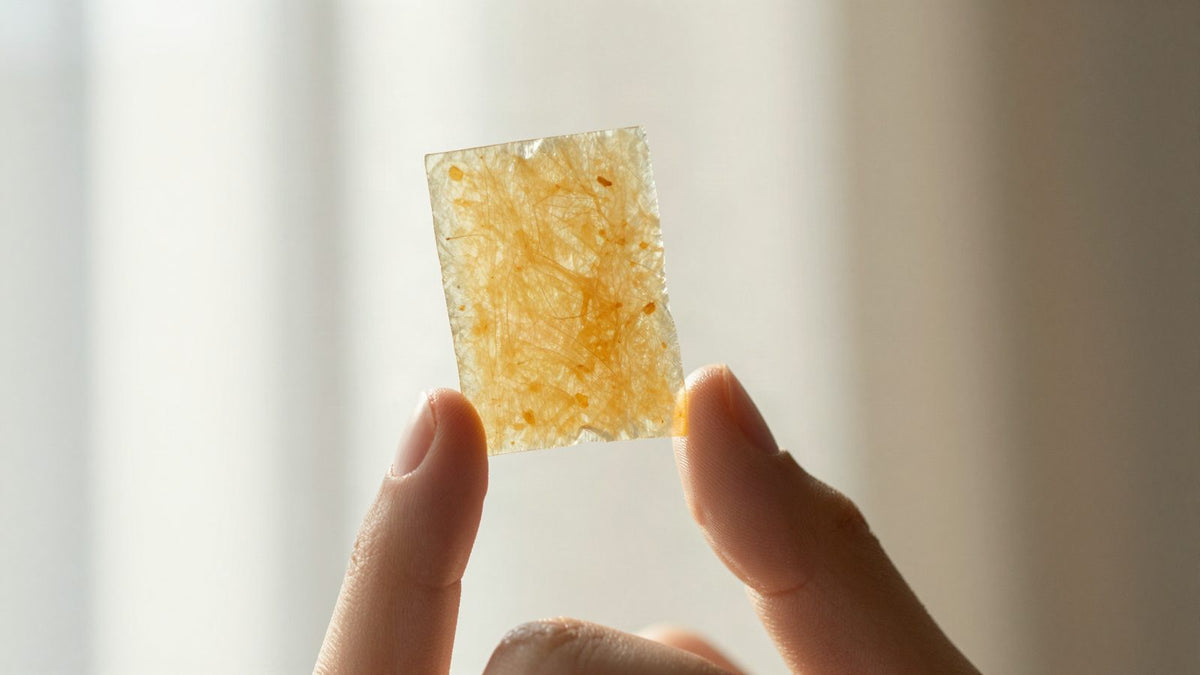
Oral thin film is a dosage form: a thin, flexible polymer layer that is placed on the tongue, wetted by saliva and broken down without water [1][2]. It can carry only a small dose. FDA has approved prescription medicines in film form, and some dietary supplements, MOODLY strips among them, use the same format [2][3].
Key facts
- Films that dissolve within about 30 seconds are classed as fast-dissolving and are typically 50 to 150 micrometers thick, according to a 2022 review [2].
- FDA's 2026 Orange Book, its list of approved drug products, includes prescription products in film form for oral use and for use in the cheek or under the tongue [3].
- Pharmaceutical researchers use roughly 50 mg of active ingredient per film as a rule of thumb [6].
- At least two published studies have used a melatonin strip in people, and a 2026 randomized study gave healthy adults a vitamin D3 film daily for 8 weeks [8][9][10].
What are oral thin film drugs?
Oral thin film drugs are prescription or over-the-counter medicines made as a film instead of a tablet, according to a 2022 review that lists both kinds [2]. The review reports that FDA approved the first prescription orodispersible film in 2010, and that several are now on the market and prescribed by doctors [2]. FDA's Orange Book lists approved products whose dosage form is film, for the oral route and for the cheek or under the tongue [3]. This page names no medicine and compares none with a supplement: a medicine's label and your pharmacist are the place for that.
How does oral thin film technology work?
Oral thin film technology starts with a polymer that dissolves in water. A 2021 review says at least 45% of the dry film must be polymer, and that 60 to 65% is usually chosen [1]. Plasticizers keep it flexible, sweeteners and flavors add taste, and food acids get saliva flowing; ingredient by ingredient, this is covered in What are oral strips made of?
Two manufacturing methods dominate, according to the 2022 review: solvent casting and hot-melt extrusion [2]. In solvent casting, the most used method in the 2021 review, the ingredients are mixed into a solution, poured out thin and dried [1]. In hot-melt extrusion, the mix is melted in a heated extruder and shaped into a film [1]. The film is made as a large sheet and cut to size [2]. Typical films break apart within 5 to 30 seconds, depending on the formula [2].
Is an orally dissolving film the same as an oral thin film?
An orally dissolving film is the same family of product under another name. Researchers and the European Pharmacopoeia say "orodispersible film", a film made mainly of a film-forming polymer [2]. FDA's drug labeling vocabulary uses "film, soluble" [4], defined in the NCI Thesaurus as a thin layer that dissolves in contact with a liquid [5]. Supplement labels may say oral strip, dissolvable strip or tongue strip.
| Name you may see | Where it is used | What it refers to |
|---|---|---|
| Orodispersible film | European Pharmacopoeia, research | A film made mainly of a film-forming polymer, placed in the mouth [2] |
| Film, soluble | FDA drug labeling codes | A thin layer that dissolves in contact with a liquid [4][5] |
| Film (oral, or cheek and under the tongue) | FDA Orange Book | Approved prescription products in film form [3] |
| Oral strip, dissolvable strip | Supplement and consumer products | The same thin format; FDA's list of supplement forms does not name strips [7] |
Are there oral thin film supplements?
Yes: some supplements are sold as films, though FDA's consumer list of supplement forms names pills, tablets, capsules, gummies, softgels, liquids and powders, not strips [7]. A film sold as a supplement still has to be swallowed to be a supplement under FDA's definition [7], and that is what happens: once a film breaks down, what it carried is swallowed with saliva [6].
Supplement films have been studied in people, in small numbers. At least two published studies have used a melatonin strip: a randomized, placebo-controlled trial gave a 1 mg strip daily for 8 weeks to adults in a clinical population, and its sleep-quality score did not change significantly in any group [9]; an open-label pilot of a 2 mg plant-derived strip, with no placebo group, was finished by 22 of 35 healthy adults [10]. A 2026 randomized study gave healthy adults 2,000 IU of vitamin D3 a day as a film for 8 weeks [8]. None tested a MOODLY strip.
The limit is the dose. At roughly 50 mg of active ingredient per film [6], a strip suits nutrients needed in small amounts, as explained in vitamin strips. Whether the film form changes what reaches your blood is a separate question, answered in Do oral strips work?
Where MOODLY fits

MOODLY makes supplement strips that melt on your tongue, one mood per tin; each one melts on your tongue in about 30 seconds. A MOODLY Sleep Strip carries melatonin 1 mg, the dose of the strip in the clinical trial above, and half the 2 mg of the pilot [9][10], plus valerian root extract 50 mg, lavender extract 20 mg, chamomile extract 10 mg and hibiscus extract 10 mg. No study has tested MOODLY Sleep Strips. More in the melatonin strips guide and the strips collection.
Related reading
- What Are Oral Strips? Supplement Strips, Explained
- Orally disintegrating tablets and under-the-tongue tablets: the difference
- What Is Pullulan?
- Strips, gummies and pills compared
Sources
- Sevinç Özakar R, Özakar E, Turkish Journal of Pharmaceutical Sciences, 2021. PubMed PMID 33634686. https://pmc.ncbi.nlm.nih.gov/articles/PMC7957312/
- Salawi A, Pharmaceuticals (Basel), 2022. PubMed PMID 35890143. https://pmc.ncbi.nlm.nih.gov/articles/PMC9323338/
- U.S. Food and Drug Administration, Approved Drug Products with Therapeutic Equivalence Evaluations (Orange Book), 46th edition, 2026. https://www.fda.gov/media/71474/download
- U.S. Food and Drug Administration, Structured Product Labeling Resources: Dosage Forms. https://www.fda.gov/industry/structured-product-labeling-resources/dosage-forms
- National Cancer Institute (NIH), NCI Thesaurus, concept C42984. https://ncit.nci.nih.gov/ncitbrowser/ConceptReport.jsp?dictionary=NCI_Thesaurus&code=C42984
- Visser JC et al., International Journal of Clinical Pharmacy, 2020. PubMed PMID 32052239. https://pmc.ncbi.nlm.nih.gov/articles/PMC7192866/
- U.S. Food and Drug Administration, Questions and Answers on Dietary Supplements. https://www.fda.gov/food/information-consumers-using-dietary-supplements/questions-and-answers-dietary-supplements
- Gervasi M et al., Scientific Reports, 2026. PubMed PMID 41720868. https://pubmed.ncbi.nlm.nih.gov/41720868/
- Castillo-Felipe C et al., Journal of Clinical Medicine, 2022. PubMed PMID 35566642. https://pmc.ncbi.nlm.nih.gov/articles/PMC9101769/
- De Jesus M et al., Alternative Therapies in Health and Medicine, 2026. PubMed PMID 40985949. https://pubmed.ncbi.nlm.nih.gov/40985949/
*These statements have not been evaluated by the Food and Drug Administration. This product is not intended to diagnose, treat, cure, or prevent any disease.


