







By Alvyn Detavernier, founder of MOODLY · Updated November 2026
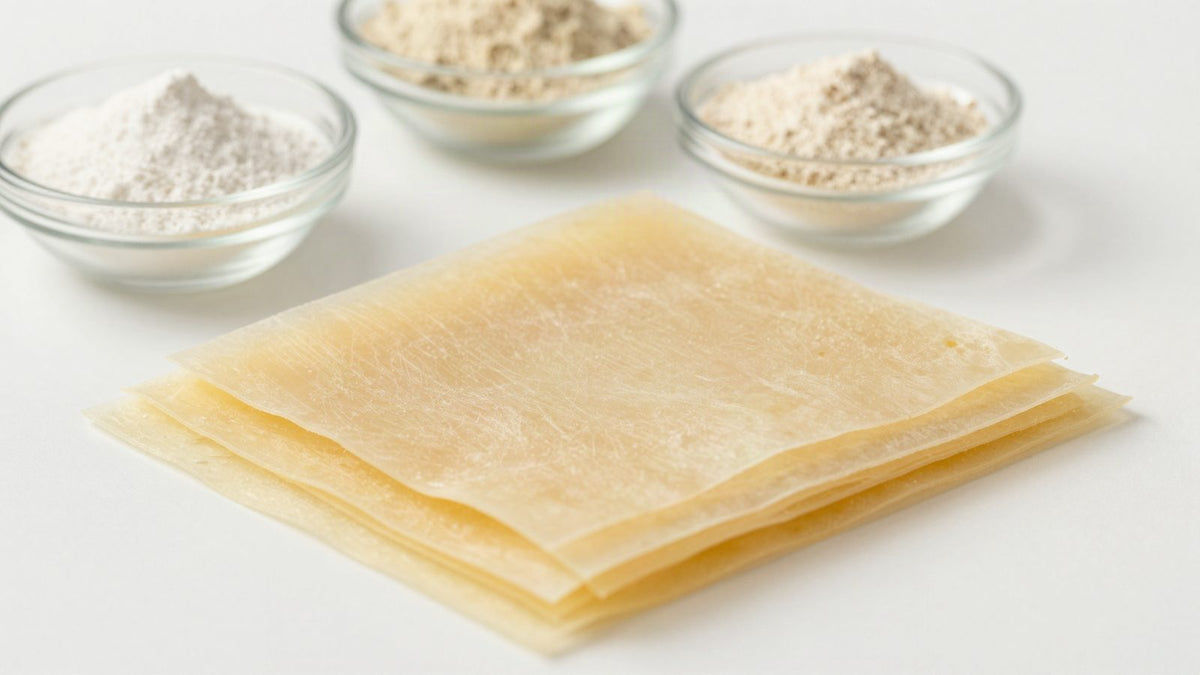
Oral strips are made mostly of a water-soluble film former, such as pullulan, that carries a small amount of active ingredient, plus a plasticizer, sweeteners, a food acid and flavor. A 2022 review puts the film former at 40 to 50% of a typical formula; a 2021 review says at least 45% of the dry film [1][2].
Key facts
- A 2022 review of orodispersible films gives typical shares of 40 to 50% film-forming polymer, up to 20% plasticizer, up to 10% sweeteners and up to 10% saliva stimulants [1].
- A 2021 review of oral thin films states that at least 45% of a dry film must be polymer, and that 60 to 65% is usually chosen [2].
- Pullulan, polyvinyl alcohol and cellulose derivatives are the most common film formers, according to the 2022 review [1].
- US labeling rules list ingredients in descending order of predominance, so the first ingredient named is present in the largest amount [3].
What goes into an oral thin film formulation?
An oral thin film formulation combines five or six kinds of ingredients, each with a job. The European Pharmacopoeia describes these films as made mainly of a polymer with film-forming capacity [1].
| Component | Typical share (2022 review) | Its job | Examples named in the reviews |
|---|---|---|---|
| Film former | 40 to 50% | Shape, strength, breaking apart in saliva | Pullulan, cellulose derivatives, pectin, gelatin [1] |
| Plasticizer | 0 to 20% | Keeps the film flexible | Sorbitol, mannitol, glycerin [1][2] |
| Sweeteners | 0 to 10% | Taste | Sorbitol, mannitol, maltitol, isomalt [1][2] |
| Saliva stimulants | 0 to 10% | Get saliva flowing | Malic, citric, ascorbic acid [1][2] |
| Colors and flavors | Colors up to 1% [2] | Look and taste | Fruit, mint or chocolate flavors |
| Active ingredients | Small: roughly 50 mg per film as a rule of thumb [4] | What the strip is for | Vitamins, melatonin, plant extracts |
The two reviews do not give the same figure for the film former: 40 to 50% in one, at least 45% and usually 60 to 65% in the other [1][2]. Either way, the film is the largest part of a strip. Some ingredients do two jobs: sorbitol and mannitol appear in the reviews both as plasticizers and as sweeteners [1][2]. These shares describe films in general, mostly medicines, not any one product.
How is a strip made?
Most films are made by solvent casting: the ingredients are mixed into a thick liquid, poured out thin, and dried until the solvent evaporates [2]. The second common method, hot-melt extrusion, melts the mix in a heated extruder and shapes it into a film [1][2]. Either way, the film is made as a large sheet and cut to size [1]. Films then take up moisture from the air, which makes them hard to protect, and foil is the most common packaging [1].
What is in dissolvable strips you can buy?
Dissolvable strips sold as dietary supplements show their contents in two places. The Supplement Facts panel lists each dietary ingredient with its amount per serving [5]. Below it comes an ingredient list, headed "Other ingredients" when the panel already names the active ones, and that list runs from the largest amount to the smallest [3]. That is where to look for the film former, the sweeteners and the acid. A step-by-step guide is in how to read a Supplement Facts label.
Two families of sweeteners show up on MOODLY labels. Sugar alcohols, such as sorbitol, xylitol, mannitol and erythritol, are sweeteners FDA permits as sugar substitutes [6]. High-intensity sweeteners, such as steviol glycosides and monk fruit extract, have been through FDA's GRAS notice program without FDA questioning the notifiers' conclusions [7].
What are pullulan strips?
Pullulan strips are films whose film former is pullulan, a carbohydrate made by fermenting starch syrup with the fungus Aureobasidium pullulans, which dissolves in hot and cold water [8]. A 2021 review notes that pullulan makes thin films with high mechanical strength that dissolve [2]. Pullulan went through FDA's GRAS notification program for use in food in general, and FDA had no questions [9]. That letter is not an approval: FDA wrote that it had not made its own determination [8]. More in What is pullulan? and, for the format itself, What is oral thin film?
Where MOODLY fits

MOODLY makes supplement strips that melt on your tongue, one mood per tin. Pullulan is the first ingredient in the list on all five labels, so it is the largest of the ingredients in that list [3]. The rest, as listed on each product page:
| MOODLY strip | Sweeteners listed | Food acid listed | Also listed |
|---|---|---|---|
| Sleep Strips | Xylitol, erythritol, sorbitol syrup, steviol glycosides | Malic acid | Cellulose, lecithin, medium chain triglycerides, raspberry flavor |
| Focus Strips | Monk fruit extract, steviol glycosides | None listed | Cellulose, lecithin, medium-chain triglycerides, xanthan gum, chocolate flavor |
| Relax Strips | Mannitol, erythritol, monk fruit extract, steviol glycosides | Malic acid | Cellulose, lecithin, pectin, strawberry and peppermint flavors |
| Libido Strips | Erythritol, sorbitol, monk fruit extract, steviol glycosides | None listed | Cellulose, lecithin, pectin, chocolate flavor. Contains: Shellfish (Oyster peptide) |
| Slim Strips | Sorbitol syrup, steviol glycoside | Malic acid | Cellulose, lecithin, mixed berry flavor |
Each active ingredient is 50 mg or less per strip, every amount printed on the tin, 30 individually wrapped strips per tin. Sleep Strips list xylitol, which FDA warns can have devastating effects on pets: keep that tin where your dog cannot reach it [10]. All five are in the strips collection.
Related reading
- What Are Oral Strips? Supplement Strips, Explained
- Pullulan: the film former, its safety and capsules
- What Is Oral Thin Film?
- Are supplement strips safe?
Sources
- Salawi A, Pharmaceuticals (Basel), 2022. PubMed PMID 35890143. https://pmc.ncbi.nlm.nih.gov/articles/PMC9323338/
- Sevinç Özakar R, Özakar E, Turkish Journal of Pharmaceutical Sciences, 2021. PubMed PMID 33634686. https://pmc.ncbi.nlm.nih.gov/articles/PMC7957312/
- Code of Federal Regulations, 21 CFR 101.4 (food labeling, designation of ingredients). https://www.ecfr.gov/current/title-21/section-101.4
- Visser JC et al., International Journal of Clinical Pharmacy, 2020. PubMed PMID 32052239. https://pmc.ncbi.nlm.nih.gov/articles/PMC7192866/
- U.S. Food and Drug Administration, FDA 101: Dietary Supplements. https://www.fda.gov/consumers/consumer-updates/fda-101-dietary-supplements
- U.S. Food and Drug Administration, Aspartame and Other Sweeteners in Food. https://www.fda.gov/food/food-additives-petitions/aspartame-and-other-sweeteners-food
- U.S. Food and Drug Administration, Aspartame and Other Sweeteners in Food (section on steviol glycosides and monk fruit). https://www.fda.gov/food/food-additives-petitions/aspartame-and-other-sweeteners-food
- U.S. Food and Drug Administration, Agency Response Letter, GRAS Notice No. GRN 000099 (pullulan), 2002, archived copy. http://web.archive.org/web/20090104211321/http://www.cfsan.fda.gov/~rdb/opa-g099.html
- U.S. Food and Drug Administration, GRAS Notice Inventory, GRN No. 99. https://www.hfpappexternal.fda.gov/scripts/fdcc/index.cfm?set=GRASNotices&id=99
- U.S. Food and Drug Administration, Paws Off Xylitol; It's Dangerous for Dogs. https://www.fda.gov/consumers/consumer-updates/paws-xylitol-its-dangerous-dogs
*These statements have not been evaluated by the Food and Drug Administration. This product is not intended to diagnose, treat, cure, or prevent any disease.


