







By Alvyn Detavernier, founder of MOODLY · Updated November 2026
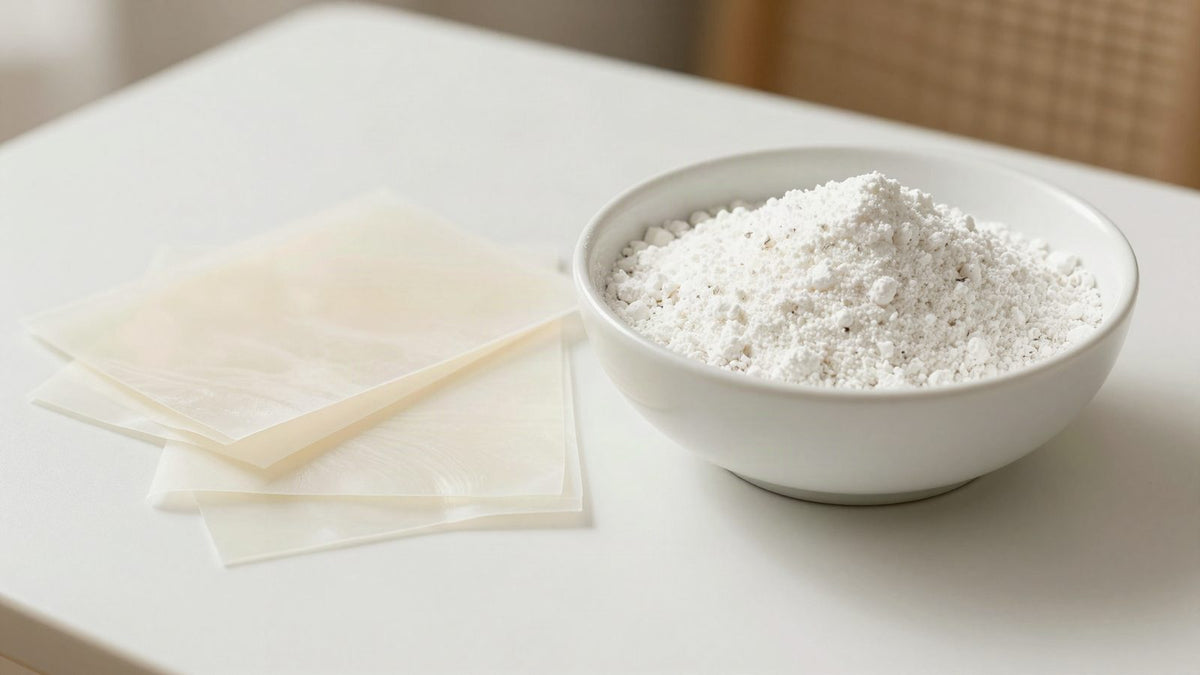
Pullulan is a carbohydrate made by fermenting starch syrup with the fungus Aureobasidium pullulans; it dissolves in water and forms strong, thin films for food, capsules and oral strips [1][2][7]. FDA had no questions about its GRAS notice for food in general, and a 2025 European re-evaluation found no safety concern at current uses [3][4].
Key facts
- In its 2002 response letter on pullulan, FDA estimated intake from the notified food uses at 10 g a day at the mean and 20 g a day at the 90th percentile [1].
- The European Food Safety Authority's 2025 re-evaluation says volunteer studies suggest mild digestive symptoms, such as bloating, may occur at 10 g of pullulan a day or more [4].
- In a 2010 crossover study, 20 healthy adults took 12 g a day of pullulan or one of three other fibers for 14 days; the four fibers were well tolerated, with mild to moderate digestive symptoms [6].
- In a 2020 lab study, pullulan capsules took up less moisture from the air than gelatin capsules, and HPMC capsules took up the least [7].
Where does pullulan come from?
Pullulan comes from fermentation: the fungus Aureobasidium pullulans makes it from starch syrup, and the producer filters and dries it [1]. EFSA describes the starting material as food-grade hydrolysed starch [4]. Chemically it is a chain of glucose units, which is why it counts as a carbohydrate [1]. Pullulan is not made from animals, unlike the gelatin used in many capsules, which a 2020 study calls "animal gelatin" [7]. The company that filed the US notice cited, as its own view, a twenty-year history of use in Japan as a food ingredient and as a bulking agent in medicines [1].
Is pullulan safe? What are the dangers?
Pullulan raised no safety concern at current uses in EFSA's 2025 re-evaluation, and the downside EFSA describes is digestive, at gram amounts. The re-evaluation says studies in adult volunteers "suggested" that mild symptoms, namely abdominal fullness, flatulence, bloating and cramping, may occur at 10 g a day or more [4]. EFSA found no need for a numerical acceptable daily intake, and adds that people with high intakes, mainly from food supplements, may get those mild symptoms [4].
In the United States, pullulan went through FDA's GRAS notification program for food in general, and FDA had no questions [3]. That letter is not an approval: FDA wrote that it had not made its own determination of the GRAS status [1].
Two human studies cited here show the dose scale. In a 2003 crossover study by industry-affiliated authors, 28 healthy adults drank 50 g of pullulan or 50 g of maltodextrin; flatulence was more frequent and more intense after pullulan [5]. In the 2010 study, 12 g a day for two weeks was well tolerated [6]. Both doses are grams. The amount of pullulan in a MOODLY strip is not printed on its label.
Pullulan vs HPMC vs gelatin capsules: what is the difference?
The three capsule shells differ in where they come from and in how they handle moisture, according to the lab studies cited here.
| Capsule shell | Made from | Moisture from the air (2020 lab study) | Release in a stomach-model device (2014 lab study) |
|---|---|---|---|
| Gelatin | Animal gelatin [7] | Took up more than pullulan [7] | The reference [8] |
| HPMC (hypromellose) | A cellulose-based polymer [7] | Took up the least [7] | Two of three tested: comparable to gelatin [8] |
| Pullulan | Fungal fermentation of starch [1] | Less than gelatin, more than HPMC [7] | Comparable to gelatin [8] |
The 2020 authors call HPMC and pullulan capsules "an attractive alternative to animal gelatin capsules" for their moisture behavior [7]. The 2014 device test, co-authored by researchers from a capsule maker, used 100 mg of caffeine per capsule [8]. Both are lab studies: neither measured anything in people.
Does pullulan have benefits?
Pullulan's job in a strip or a capsule is technical: it forms the film or the shell [2]. In the body, EFSA reports that, in lab tests, pullulan is broken down by digestive enzymes from saliva, the pancreas and the intestine, and fermented in the colon into short-chain fatty acids [4]. The 2003 authors concluded it is "digested slowly" [5]. The company that filed the GRAS notice described pullulan as "soluble" fiber, and FDA's food additive office did not evaluate any claim about such benefits [1]. The studies used 12 to 50 g. We claim no benefit for the pullulan in a strip.
Where MOODLY fits

MOODLY makes supplement strips that melt on your tongue, one mood per tin. Pullulan is the first ingredient listed on all five labels, and US rules order that list from the largest amount to the smallest [9]. The amount per strip is not printed. What else goes into a strip is in What are oral strips made of?, and the five strips, with every dose, are in the strips collection. Ingredient by ingredient: our ingredients page.
Related reading
- What Are Oral Strips? Supplement Strips, Explained
- Oral thin film: medicines, supplements and manufacturing
- Are Supplement Strips Safe?
- Strips, gummies and pills compared
Sources
- U.S. Food and Drug Administration, Agency Response Letter, GRAS Notice No. GRN 000099 (pullulan), 2002, archived copy. http://web.archive.org/web/20090104211321/http://www.cfsan.fda.gov/~rdb/opa-g099.html
- Sevinç Özakar R, Özakar E, Turkish Journal of Pharmaceutical Sciences, 2021. PubMed PMID 33634686. https://pmc.ncbi.nlm.nih.gov/articles/PMC7957312/
- U.S. Food and Drug Administration, GRAS Notice Inventory, GRN No. 99. https://www.hfpappexternal.fda.gov/scripts/fdcc/index.cfm?set=GRASNotices&id=99
- EFSA Panel on Food Additives and Flavourings, EFSA Journal, 2025. PubMed PMID 40078887. https://pubmed.ncbi.nlm.nih.gov/40078887/
- Wolf BW et al., Journal of Nutrition, 2003. PubMed PMID 12672917. https://pubmed.ncbi.nlm.nih.gov/12672917/
- Stewart ML et al., Annals of Nutrition and Metabolism, 2010. PubMed PMID 20090313. https://pubmed.ncbi.nlm.nih.gov/20090313/
- Yang N et al., International Journal of Biological Macromolecules, 2020. PubMed PMID 32439451. https://pubmed.ncbi.nlm.nih.gov/32439451/
- Garbacz G et al., European Journal of Pharmaceutical Sciences, 2014. PubMed PMID 24021609. https://pubmed.ncbi.nlm.nih.gov/24021609/
- Code of Federal Regulations, 21 CFR 101.4. https://www.ecfr.gov/current/title-21/section-101.4
*These statements have not been evaluated by the Food and Drug Administration. This product is not intended to diagnose, treat, cure, or prevent any disease.


