







By Alvyn Detavernier, founder of MOODLY · Updated November 2026
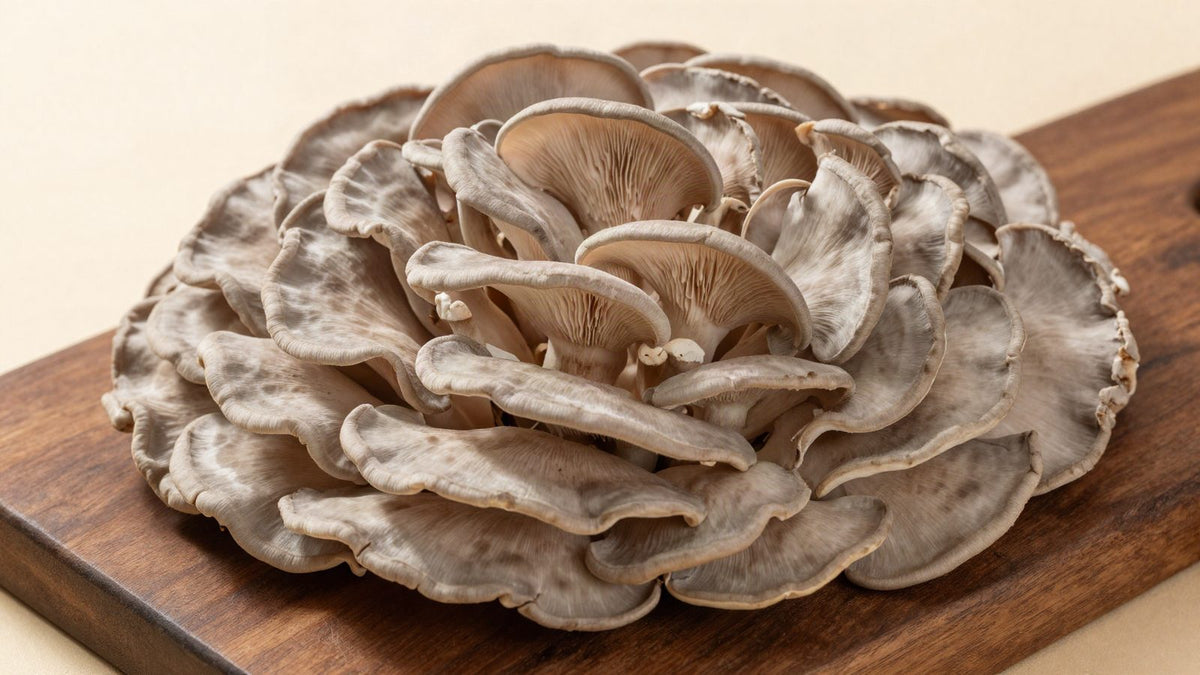
Maitake mushroom (Grifola frondosa) is an edible fungus, also called hen-of-the-woods, that grows around the stumps or trunks of broadleaf trees and is eaten young [1]. Human research on it is thin: the healthy-adult trials we found baked whole maitake into bread [2][3], and a 2009 systematic review found a lack of systematic study in humans [4].
Key facts
- In Japanese, "mai" means dance and "take" means mushroom; in the US and Canada maitake is also called sheep's head, king of mushrooms, hen-of-the-woods and cloud mushroom [1].
- Japan was one of the first countries to cultivate maitake, starting in the mid-1980s [1].
- USDA FoodData Central lists 100 g of maitake at 2.2 g of protein, 3.1 g of fiber and 2.26 g of beta-glucan [5].
- A 2026 trial gave 47 healthy adults aged 60 and over bread with 50 g of maitake daily for 18 weeks, which is 2,000 times the 25 mg in a MOODLY Focus Strip [2].
Is maitake the same as hen of the woods?
Maitake and hen-of-the-woods are the same mushroom, Grifola frondosa [1]. It belongs to the family Grifolaceae, in the order Polyporales [1]. Maitake is the Japanese name for its edible fruiting body, the part people cook [1].
Two parts of it are grown. The fruiting body is cultivated, in Japan mostly in plastic bags [1]. The mycelium is grown either on sawdust mixed with rice or wheat bran, or in liquid [1]. A supplement can come from either, which is why the part used matters: see mycelium vs fruiting body.
Maitake mushroom vs shiitake: what is the difference?
Maitake and shiitake are two different edible mushrooms. Maitake (Grifola frondosa) grows around the stumps or trunks of broadleaf trees [1]; shiitake (Lentinula edodes) is a dietary staple in Asia [7].
| Maitake | Shiitake | |
|---|---|---|
| Latin name | Grifola frondosa [1] | Lentinula edodes [7][8] |
| Other names | Hen-of-the-woods, sheep's head, cloud mushroom [1] | Lentinus edodes on some labels, ours included |
| Per 100 g, protein [5][6] | 2.2 g | 2.41 g |
| Per 100 g, fiber [5][6] | 3.1 g | 4.2 g |
| Per 100 g, beta-glucan [5][6] | 2.26 g | 2.92 g |
| Healthy-adult trials found | Whole maitake in bread, 11 to 18 weeks [2][3] | See our shiitake page |
| Reported reactions | A clotting-test rise with a blood thinner, in a case report [9] | A rare skin rash, mostly from raw or undercooked shiitake [8]; a rise in eosinophils with daily powder [7] |
| Per MOODLY Focus Strip | 25 mg | 20 mg |
More on shiitake: shiitake mushroom supplement.
What did maitake studies use?
The maitake trials in healthy adults that we found used the whole mushroom as food, in bread, for 11 to 18 weeks. In 47 healthy adults aged 60 and over, bread with 50 g of maitake was eaten daily for 18 weeks; one of the two strains tested scored better than placebo on a thinking test, and the other did not [2]. In a second 2026 trial, healthy adults aged 18 to 20 and 40 to 85 ate maitake bread daily for 11 or 18 weeks, and researchers measured immune markers and symptoms; the overall number of symptom episodes did not differ between groups [3].
Many of the other human records we found were studied in clinical settings, and a 2009 systematic review found "a lack of systematic study on the safety and effectiveness of maitake in humans" [4]. We found no maitake trial on thinking or focus at supplement amounts.
What are maitake mushroom side effects?
Maitake side effects in people are poorly documented: the 2009 review found a lack of systematic study on safety [4], and in the 18-week bread trial no one stopped because of adverse effects [2]. The human case report we found describes a rise in a blood-clotting test (INR) when a maitake extract was taken with a prescription blood thinner [9].
So ask a doctor or pharmacist first if you take a blood thinner or any medication: FDA notes that supplements can change how a medication is taken up or cleared [10]. Pregnant or nursing? Many supplements have not been tested in pregnant women or nursing mothers [11]. Reactions reported for other functional mushrooms are in are mushroom extracts safe?
Where MOODLY fits

MOODLY makes supplement strips that melt on your tongue, one mood per tin. MOODLY Focus Strips hold maitake 25 mg, with lion's mane 30 mg, cordyceps 25 mg and shiitake 20 mg, and no caffeine listed on the label. The maitake trials used 50 g of whole mushroom in bread, 2,000 times a strip [2]. Whether the strip's maitake is fruiting body or mycelium, extract or powder, is a question we have put to our supplier.
No study has tested MOODLY Focus Strips, and we make no promise for them. One strip a day at most, adults 18 and over. All four mushrooms, with study amounts, are in our mushroom focus strips guide and the MOODLY ingredients list.
Related reading
- Shiitake Mushroom Supplement: What Do Studies Show?
- Mycelium vs fruiting body
- Are Mushroom Extracts Safe?
- What's in mushroom focus strips
Sources
- Wu JY et al., Foods, 2021. PubMed PMID 33466429. https://pmc.ncbi.nlm.nih.gov/articles/PMC7824844/
- Jogi EM et al., Journal of Nutritional Science and Vitaminology, 2026. PubMed PMID 42055721. https://pubmed.ncbi.nlm.nih.gov/42055721/
- Masuda Y et al., Food and Function, 2026. PubMed PMID 42627298. https://pubmed.ncbi.nlm.nih.gov/42627298/
- Ulbricht C et al., 2009. PubMed PMID 19476741. https://pubmed.ncbi.nlm.nih.gov/19476741/
- USDA FoodData Central, Mushroom, maitake (FDC ID 2003602). https://fdc.nal.usda.gov/food-details/2003602/nutrients
- USDA FoodData Central, Mushrooms, shiitake (FDC ID 1999628). https://fdc.nal.usda.gov/food-details/1999628/nutrients
- Levy AM et al., Journal of Allergy and Clinical Immunology, 1998. PubMed PMID 9600497. https://pubmed.ncbi.nlm.nih.gov/9600497/
- Nguyen AH et al., International Journal of Dermatology, 2017. PubMed PMID 28054338. https://pubmed.ncbi.nlm.nih.gov/28054338/
- Hanselin MR et al., Annals of Pharmacotherapy, 2010. PubMed PMID 20040699. https://pubmed.ncbi.nlm.nih.gov/20040699/
- U.S. Food and Drug Administration, Mixing Medications and Dietary Supplements Can Endanger Your Health. https://www.fda.gov/consumers/consumer-updates/mixing-medications-and-dietary-supplements-can-endanger-your-health
- NIH National Center for Complementary and Integrative Health, Using Dietary Supplements Wisely. https://www.nccih.nih.gov/health/using-dietary-supplements-wisely
*These statements have not been evaluated by the Food and Drug Administration. This product is not intended to diagnose, treat, cure, or prevent any disease.


