







By Alvyn Detavernier, founder of MOODLY · Updated November 2026
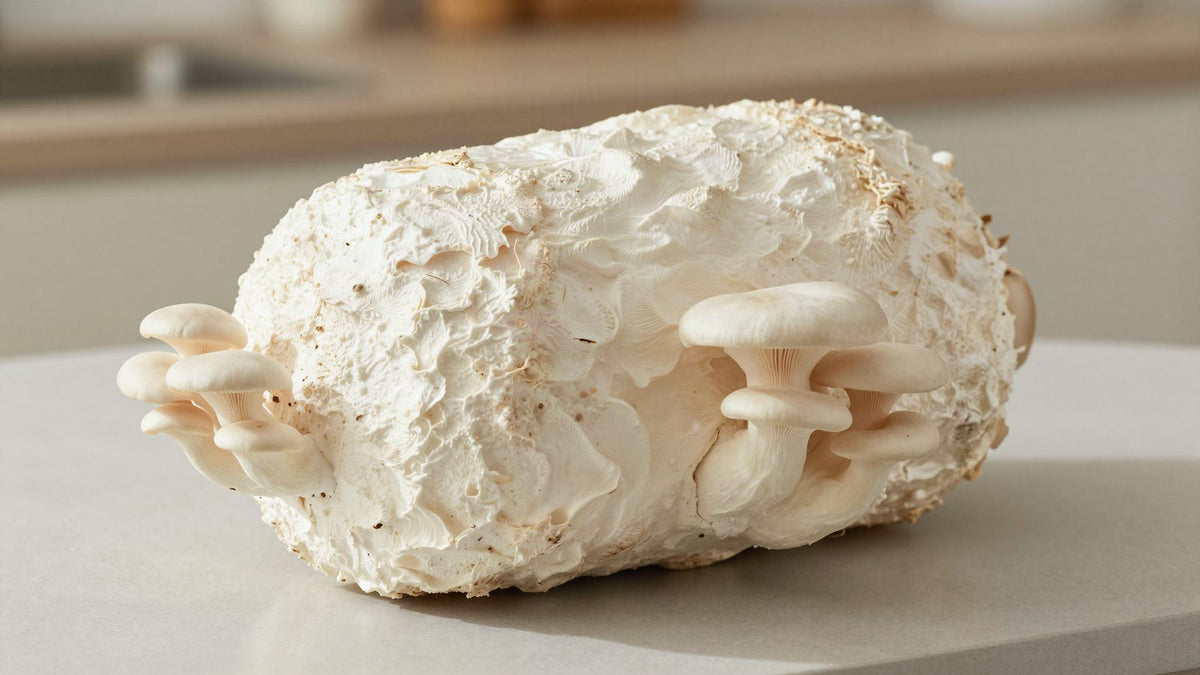
The fruiting body is the mushroom itself, with its stalk, cap and gills, while the mycelium is the fungus's cotton-like growth, which lives below ground and can be grown in tanks or on grain [1][2][3]. The two share one genome but express genes differently, and their compounds vary, so a supplement label should say which part it uses [1][3].
Key facts
- In shiitake, one study counted 2,080 genes expressed differently between the two stages: 1,503 higher in the mycelium and 577 higher in the mature fruiting body [1].
- A commercial lion's mane powder tested in 2025 was "mycelial biomass and fruiting body cultured on oats" [3].
- A 2025 analysis of chaga supplements found grain fermented with mycelium to be starch-rich, unlike wild chaga; five of its six authors work for a company that sells chaga supplements [4].
- The European Food Safety Authority judged that side effects reported for the shiitake fruiting body were not relevant to a fermented, heat-sterilized shiitake mycelium extract [6].
Mushroom supplements: mycelium vs fruiting body, what differs?
Mycelium and fruiting-body supplements differ in which life stage they come from, what they are grown on, and how much of each compound they hold [1][3]. Mushroom supplements are often extracts made from one chosen stage, and their makeup varies with where they are grown and how they are processed [3].
The mycelium can be grown on a solid base, such as sawdust with rice or wheat bran, or in liquid [2]. When it grows on grain, the grain can end up in the product: one lion's mane powder was mycelium and fruiting body "cultured on oats" [3], and chaga products made from fermented grain tested starch-rich [4]. Compound levels shift too. In a 2014 lab analysis, cordycepin was found in Cordyceps militaris fruit bodies but not detected in the Ophiocordyceps sinensis mycelium tested, a comparison where species and part both change [5]. For cordyceps, see cordyceps militaris vs sinensis.
Which is better, mycelium or fruiting body?
Neither mycelium nor fruiting body has been shown to be better in people, because we found no human trial comparing the two head to head. Trials simply used different forms.
| Form used | Mushroom | Amount a day | Who, how long |
|---|---|---|---|
| Fruiting-body powder [9] | Lion's mane | 3.2 g | Healthy adults over 50, 12 weeks |
| Fruiting bodies [10] | Lion's mane | 1 g, once | 40 healthy adults, one dose |
| Fruiting-body extract, 10:1 [7] | Lion's mane | 3 g, once | 18 healthy adults, one dose |
| Mycelium grown in liquid [12] | Lion's mane | 3 g | 13 healthy adults, 7 days |
| Mycelium, enriched in one compound [11] | Lion's mane | 1.05 g | Older adults, clinical population, 49 weeks |
| Mycelium and fruiting body [13] | Lion's mane | 2 g | 10 healthy adults, 28 days |
| Blend, part not stated [14] | Lion's mane | 1.8 g | 41 healthy adults, 28 days |
| Fermented mycelium culture, Cs-4 [15] | Cordyceps (sinensis) | About 1 g | Adults 50 to 75, 12 weeks |
The form can change safety judgments too. The European Food Safety Authority judged that side effects reported for the shiitake fruiting body were not relevant to a fermented, heat-sterilized shiitake mycelium extract, while not excluding an allergy risk for sensitive people [6]. Note who argues each side: the starch finding came from authors employed by a company that sells chaga supplements [4].
Mushroom extract vs powder: what is the difference?
A mushroom powder is the dried, ground material, while an extract pulls compounds out with a solvent and is then dried. In a 2024 lab study, the powder was freeze-dried fruiting bodies ground fine [8]. In a 2025 lion's mane trial, the extract was made from fruiting bodies with water and ethanol (8:2), then spray-dried onto maltodextrin, a carrier [7]. The trial calls it a "10:1 extract" [7]; a label that prints such a ratio should say what it means.
The trial's authors add that extracts are not interchangeable: they vary with the raw material, the extraction method and what ends up in the extract [7].
Mushroom extract vs fruiting body: are they opposites?
An extract and a fruiting body are not opposites, since an extract can be made from a fruiting body, as in the 2025 trial [7]. The real questions are two: which part was used, and was it extracted or simply dried and ground? A label can answer both. Look for the Latin name, the part (fruiting body, mycelium or both), any grain substrate, whether it is an extract and at what ratio, and the amount per serving on the Supplement Facts panel [16]. Maitake shows how both parts are farmed: see what is maitake mushroom?
Where MOODLY fits

MOODLY makes supplement strips that melt on your tongue, one mood per tin. The MOODLY Focus Strips label lists each mushroom with its amount: lion's mane 30 mg, maitake 25 mg, cordyceps 25 mg and shiitake 20 mg, with no caffeine listed. It does not yet say fruiting body or mycelium, extract or powder. We have asked our supplier, and this page will say so when we know.
No study has tested MOODLY Focus Strips. Study amounts for each mushroom are in our mushroom focus strips guide and on our lion's mane page.
Related reading
- What Is Maitake Mushroom?
- Cordyceps militaris vs sinensis
- Shiitake Mushroom Supplement: What Do Studies Show?
- Are mushroom extracts safe?
Sources
- Berger RG et al., Microorganisms, 2022. PubMed PMID 35889098. https://pmc.ncbi.nlm.nih.gov/articles/PMC9315710/
- Wu JY et al., Foods, 2021. PubMed PMID 33466429. https://pmc.ncbi.nlm.nih.gov/articles/PMC7824844/
- Mahadevan K et al., Frontiers in Toxicology, 2025. PubMed PMID 41230556. https://pubmed.ncbi.nlm.nih.gov/41230556/
- Windsor C et al., International Journal of Molecular Sciences, 2025. PubMed PMID 40243601. https://pubmed.ncbi.nlm.nih.gov/40243601/
- Cohen N et al., International Journal of Medicinal Mushrooms, 2014. PubMed PMID 24941169. https://pubmed.ncbi.nlm.nih.gov/24941169/
- EFSA NDA Panel (European Food Safety Authority), EFSA Journal, 2010. PubMed PMID 42005752. https://pubmed.ncbi.nlm.nih.gov/42005752/
- Surendran G et al., Frontiers in Nutrition, 2025. PubMed PMID 40276537. https://pmc.ncbi.nlm.nih.gov/articles/PMC12018234/
- Kała K et al., Pharmaceuticals (Basel), 2024. PubMed PMID 39065803. https://pmc.ncbi.nlm.nih.gov/articles/PMC11279603/
- Saitsu Y et al., Biomedical Research, 2019. PubMed PMID 31413233. https://www.jstage.jst.go.jp/article/biomedres/40/4/40_125/_pdf
- La Monica MB et al., Nutrients, 2023. PubMed PMID 38140277. https://pmc.ncbi.nlm.nih.gov/articles/PMC10745489/
- Li IC et al., Frontiers in Aging Neuroscience, 2020. PubMed PMID 32581767. https://pubmed.ncbi.nlm.nih.gov/32581767/
- Xie XQ et al., Nutrients, 2021. PubMed PMID 33800983. https://pmc.ncbi.nlm.nih.gov/articles/PMC8004025/
- Evans C et al., Nutrients, 2026. PubMed PMID 42884628. https://pubmed.ncbi.nlm.nih.gov/42884628/
- Docherty S et al., Nutrients, 2023. PubMed PMID 38004235. https://pmc.ncbi.nlm.nih.gov/articles/PMC10675414/
- Chen S et al., Journal of Alternative and Complementary Medicine, 2010. PubMed PMID 20804368. https://pmc.ncbi.nlm.nih.gov/articles/PMC3110835/
- U.S. Food and Drug Administration, FDA 101: Dietary Supplements. https://www.fda.gov/consumers/consumer-updates/fda-101-dietary-supplements
*These statements have not been evaluated by the Food and Drug Administration. This product is not intended to diagnose, treat, cure, or prevent any disease.


